
Innovative Audio-Visual Technologies Transforming Sports Venues
A stadium has always been way more than a place where people go to watch games; they are centers of entertainment where fans are entertained in various forms. In the last few years, especially in large conference venues, conventional halls have become smarter, technologically converted audio-video (AV) halls. Hence, this article seeks to reveal some of the most revolutionary innovations in sports venues’ audio-video technologies today.
1. High-Definition Video Displays
High-definition (HDTV) and ultra-HDTV (4K and 8K) are widely used throughout contemporary sports complexes. Such big LCD screens will display high definition images and are useful for live broadcasts of the games in progress, rebroadcasts of game highlights, as well as advertisements. The technology is not only useful to the fans that are still in the stand, but also boosts the quality of the replay or highlights shown on the big screen.
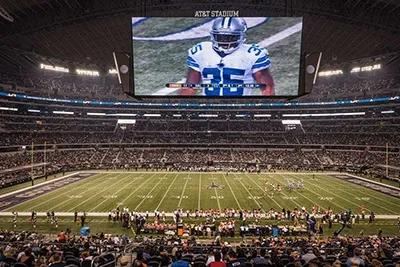
- LED Screens: LED (light-emitting diode) screens are common nowadays because of the light intensity, energy saving and clear pictures on the screen. They are most of the time found in jumbotrons and within the venue for commercial breaks and real-time scores.
- Curved Displays: In some places, curved displays are installed to extend the display on the stands or in the field adding value to it that cannot be overlooked. It is possible to alter the projections, where these screens can change their incline, depending on the position of the viewers.
| Also Read: Future-Proofing Sports Venues: Trends in Technology Adoption |
2. Advanced Sound Systems
Just like in the case of graphics and visuals, sound is a vital part of the experience; of sports events in particular. Hi-tech acoustic solutions make it possible for the fans to hear all the plays, commentaries, and announcements.

- Directional Speakers: These speakers have directionality which means that sound is directed in certain directions hence minimizing noises which generally interfere with the announcements or messages that are required to be relayed to different sections in the venue.
- 3D Audio: This technology adds a more realistic quality to the audio since it will add the feel of sounds coming from all directions similarly to a three dimensional world. For instance, it makes fans feel like they are in the middle of it all regardless of sporting events or their favorite band.
It is also shown how technology can make the relationship between fans and productions more immediate and the fans can take part in interactive processes.
3. Interactive Fan Engagement
Information and Communications Technologies (ICT) are making fans players; this has been possible because of the technologies, fans are given the feeling that they are playing the game.

- Augmented Reality (AR): AR overlays online content on the physical world through the smartphone or AR glasses. AR applications can be used where the fans can see the statistical details, the profile of the players, and other useful information relating to the game at the time of watching it.
- Virtual Reality (VR): This differs in that VR creates an environment that the fans can engage with and interact in. It also said that some of the venues took fans to a field through VR through giving a virtual tour of the stadium or simulating game situations.
4. Enhanced Connectivity and Mobile Integration
As for the role of innovation in sports venues, the provision of connectivity is done through smartphones and mobile apps.

- Wi-Fi and 5G Networks: Internet connectivity such as Wi-Fi connectivity and 5G networks enable fans to stream, tweet, use apps, and share comments and emojis in real time. This helps fans to be able to share their experiences and be connected at all times without any disruptions.
- Mobile Apps: Some venues are investing in mobile applications that include options like seat upgrading, food, and drink ordering, and real-time games’ information. These applications make a fan’s experience better by enhancing their ability to better navigate the facility and get services.
5. Data-Driven Insights
Modern AV technologies are also using data to enrich the overall experience in the venue.
- Analytics and AI: The information analysis useful for statistics and AI helps better understand fans, their inclinations, and their response to fan-related events. This information proves useful when it comes to positioning of the seats, sale of foods and beverages, as well as general management of the venue.

- Smart Lighting: Smart lighting measures shifting that is in dependent of the time of the day, game events, and the mood of the spectators. For instance, illumination may be adjusted to the team’s colours or enhance relevant occasions in the match.
6. Seamless Integration and Control Systems
In a sports venue, there are several types of AV technologies that need to be managed, and for this purpose, the control systems must be quite complex.
- Centralized Control Systems: These systems enable the operators to control all the computationally strenuous AV equipment from a single interface and safeguard the efficiency and coordination with live events.

- Automated Systems: Several components such as lighting, sounds, as well as video displays are easily controlled through automation. For instance, lighting and sound can be automatically regulated depending on the stage of the game or the time of day.
Conclusion
Advanced systems in acoustics and music have revolutionized sporting arenas and in the process made them a bit more fun for the spectators. These technologies ranging from video sprites and acoustics, social media fan engagement, and smart connectivity are improving the vistas of sports events attendance. But surely over time as technology enhances people will start to experience even more fabulous innovations in the sports venue.
 Media Pack Download
 Newsletters
 Industrial Events