
The Journey towards Accessibility in Professional Sports
The access to professional sporting events has become an important discussion as the members of the sports-related industries seek to ensure that everybody may participate in them fully – athletes, fans, and everyone else who is interested in the sporting events industry. Starting from devices to policies, the entire drive has been evolving and has been on the path of making it accessible. In the subtopics below, we will look at the various ways accessibility is changing, why this is important, and what actions businesses and organizations should consider taking towards making their environment more inclusive.
The Importance of Accessibility in Sports
Sports cut across culture, disability and geographical location. While accessibility in sports refers to the physical adjustment to accommodate disabled athletes, increase their access to broadcasts and integration of disabled personnel into the sports workforce.
Why It Matters?
- For Athletes: Individuals with disabilities or other limitations require equality to have an opportunity and achieve in sports.
- For Fans: Accessible venues and media allow every person to embrace a live match or a game broadcast.
- For Industries: Evaluation brings in the diverse talent pool, thus making them more accessible to the customer, will influence overall revenues and brand loyalty.
Milestones in the Accessibility Journey
Historical Overview
The admission of disabled athletes to the Paralympic Games as well as Special Olympics was suggestive of the social justice culture. The historic Paralympics were held in Rome in 1960 – an event that was not only powerful but effecting to demonstrate the world that sport can and must include people with disabilities. Over the years, new technologies have continued to open other barriers for the adaptive schemes.
Technological Innovations
Accessibility has been revolutionized by innovations like:
- Prosthetic Technology: Prosthetics are now lightweight and offer high performance that makes the athletes with such artificial limbs to compete at high levels.
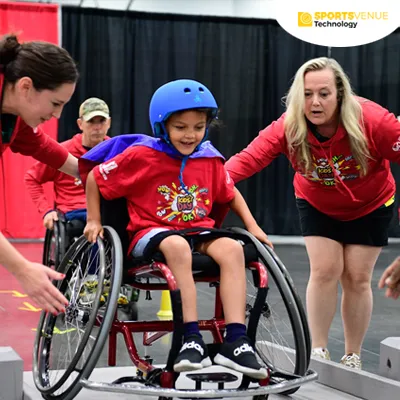
- Assistive Devices: Competitive basketball, rugby or racing wheelchairs we use are custom-built.
- Digital Accessibility: Any fans who are visually impaired can use voice navigation and screen readers to follow sports news and even buy a ticket online.
Policy and Advocacy
This is the reason why organizations like the International Paralympic Committee (IPC) and grass root movements have all provided significant drive for the concept of accessibility. The mandates such as the Americans with Disabilities Act (ADA) have also provided standards that developing accessible sports facility in the United States should embrace.
Accessibility Challenges in Professional Sports
Despite progress, challenges persist in achieving full inclusivity:
- Inaccessible Infrastructure: Lack of ramps, lifts and disabled seating in stadiums and training pitches remains a big challenge to people with disabilities.
- Limited Representation: Professional sports can rarely accommodate diverse ability, both in players and coaches and administrative positions.
- High Costs: It is a fact that adaptable tools and barriers free transmitting methods are very costly.
- Limited Awareness: Some organizations are unaware of accessibility, believing that it expands the audience base and influence of the organization.
The Role of Technology in Advancing Accessibility
Technology is still playing an important role in the successful transition to being accessible.
Virtual Reality (VR) and Augmented Reality (AR)
- Allow fans to enjoy games from home with the ‘fun’ accessibility features like subtitling, sign language interpreting, and adaptive environment.
AI-Powered Solutions
- The use of AI in transcription can help in real time captioning for events is to be made accessible for deaf people
Wearable Technology
- Biometric Data Monitors like wearable devices like heart rate monitor and GPS trackers designed for disabled athletes improve physical performance parameters
Actionable Advice for Sports Businesses
Businesses in the sports ecosystem - stadium owners, technology providers, or broadcasting companies - can take proactive steps:
- Conduct Accessibility Audits - Identify whether physical environments, a company’s website, or services meet specific accessibility standards. Involve many different users in the evaluation of the usefulness.
- Invest in Training - Train employees how to take care of fans and athletes with disability in order to be friendly.
- Partner with Experts - Make partnerships with organizations that focus on disability issues or accessibility.
- Leverage Universal Design - Facilities and products designed for the ADA and other similar services such as universally designed seating or an easy to access digital platform.
FAQs about Accessibility in Professional Sports
Q1: How can stadiums become more accessible?
Ramps, elevators and seats that can easily be booked by persons with challenged mobility make stadium more accessible. Braille signs and aids for the hearing impaired enhance the fans’ experience for everyone else as well.
Q2: What sports are most accessible to athletes with disabilities?
Para sports such as wheel basketball, para swimming and adaptive skiing are highly achievable since there are existing structures and people in-place.
Q3: What role do businesses play in promoting accessibility?
Other forms of para sports for instance; wheel basketball, para swimming and adaptive skiing are very possible because structures and individuals are already in place As dungeons, Americans would be most effective participating in highly achievable para sports including;
Success Stories in Accessibility
Nike’s FlyEase Sneakers
Nike’s latest innovation of hands-free shoes commonly known as FlyEase is an embodiment of accessible sportswear. These type of shoes are meant for people with restricted mobility and are stylish as well as comfortable.
Accessible Sports Arenas
Most stadia have cultural establishments like sensory room, the seating area for the wheelchair confined guests, and braille signages as can be seen at the Tottenham Hotspur Stadium in London to show that fans inclusion will improve the experience.
Looking Ahead: Accessibility Trends in Sports
Adaptive e-sports
Historically, the advent of e-sports offers a chance for athletes with a disability. To promote exercise for disabled inhabitants, products of gaming that are easily available also support disabled inhabitants accommodate devices.
Inclusive Broadcasting
Sport organizations are featuring Live Captioning, Audio Description, and Multi-Language for all people in the broadcast stations.
Sustainable Accessibility
Advent technological advances in aspects such as 3D printing and environment friendly material, the cost of making the equipment and its impacts on the environment are decreasing.
Conclusion:
Sport for slow learners can be heralded as a social process that entails imposition from sporting Olympians, employees, corporate organizations, and government. Through use of innovation technology, supporting policies for the disabled and practicing Universal Design, The sports industry can become more imaginative. As firms come into their own, they effectively promote equity but also create avenues for connecting and expanding an organization’s stakeholders. The main message is that getting to the goal of full accessibility may take a very long time; but even small achievements are important.
 Media Pack Download
 Newsletters
 Industrial Events