
Immersive Audio-Visual Systems Transforming Live Sports Experiences
The Modern Stadium Is Competing With Your Living Room
Back in the day, when you were at a sporting event you had to compromise. Long lines for concessions, small chances at a replay, and a viewing experience that was dependent on seating were all accepted by the fans. When they missed a crucial moment there was little chance of seeing it again.
That equation has changed.
Today's fans go to a stadium with devices that will broadcast games in ultra-high definition, supply real-time stats, and offer access to a host of entertainment. Now, the task for the venue operators is not only about filling up seats, but creating a positive impact. It's making people believe that the person here is providing them with the thing that they can't get elsewhere.
This evolution has unknowingly reshaped tech's place within sports arenas.
From being classified as supporting infrastructure, it has become a strong draw for itself. Vast signage prevails. Sound systems are designed similarly as concert halls. Digital content is customized to keep the excitement going from the gates open through the end whistle.
This creates a new generation of sports facilities in which the experience goes beyond the game.
A Different Kind of Arms Race
For decades, stadium improvements have been all about the physical changes – more seats, better food and drink options, bigger hospitality areas and better parking. Those investments are still important but no longer the competitive edge of a venue.
The difference is more and more being created by Sports Venue Technology.
Teams and venue operators are aware of the changing expectations of fans. People who come in for many hours at an event are looking for entertainment, information, convenience, and connectivity to come together.
A venue can have the world's best athletes, but if the fans don't know what is happening, can't hear what is announced or have no idea of what to do, the entire event isn't enjoyable.
This reality explains why technology budgets have become a central component of stadium development projects worldwide.
The traditional view of audio, video, lighting, networking and content platforms as separate entities is now being replaced by an interdependent, coordinated ‘ecosystem’ design.
Why Sound Often Matters More Than Screens
Video displays usually receive the most attention during a stadium renovation. They are easily seen, impressive, and marketable.
However, many venue owners say the biggest distinction is for many times brought about by audio.
Consider the moments that define live sports. The eruption of noise after a last-minute goal. The anticipation generated during player introductions. The collective energy of thousands of fans responding to a familiar anthem.
Those experiences depend heavily on Stadium Sound Systems.
Older facilities often faced problems of uneven coverage. Announcements could be heard clearly for fans in one area, but were confusing or sounded as if they were echoing for fans in another. Sophisticated acoustic modeling and digital signal processing are covered in modern systems and alleviate those problems.
Today, engineers study the geometry of seating areas, the properties of building materials and the behavior of crowds before deciding where speakers should be put. The objective is not simply volume. It is consistency.
When audio is delivered properly, spectators rarely notice the technology. They just feel more "in" it.
One of the greatest benefits of modern stadium design has been the understanding that this emotional bond can be created.
The Evolution of Visual Storytelling
Scoreboards were used to get the important information across at sports arenas. In today's world, visual content is a great storytelling tool.
Today's LED displays for sports arenas provide much more than just game scores and timers. They offer context, raise anticipation and offer entertainment opportunities throughout an event.
Player introductions, historical moments or behind-the-scenes footage can be displayed, before a match. During the game, they provide replays, stats, and content for the audience.
When they're not in use, they are a space for sponsor activations, fan competitions and social media interactions.
What makes current-generation displays particularly effective is their versatility. The content may change at a moment's notice depending on the game conditions, on the reactions of the audience, or on commercial considerations.
This facilitates the keeping of the attention of the audience when the action on the field slows down.
Many times, a person will recall a game after a game, as well as the way it was marketed before and after the match.
When Everything Works Together
Not all the most successful venues have to have the biggest screens, or the loudest speakers.
They are the venues where every technological element feels connected.
This philosophy sits at the heart of Immersive AV systems for stadiums.
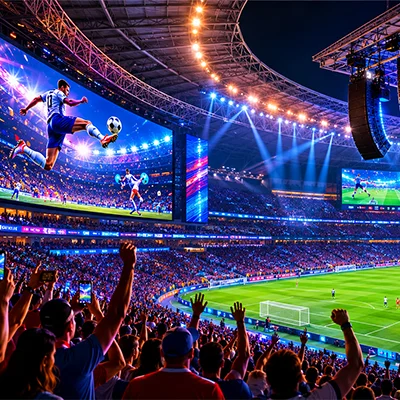
Imagine a championship game reaching its final moments. A dramatic video sequence appears across the venue's displays. Lighting effects sweep through the crowd. Audio builds tension. Digital boards display real-time statistics. Thousands of people become part of an experience that is much more than a competition.
No single element of these works in isolation. They are synchronized through integrated systems designed to create emotional impact.
This integration has grown more significant as venues look to make sporting events a form of entertainment that has the same attractiveness as a concert, streamed service, or other leisure activity.
Beyond Entertainment: The Practical Side of AV Technology
Although fan engagement is the focus of much discussion about stadium innovations, there is another side to it.
The role of sports arena audio-visual technology is a critical one.
Large venues need to be able to communicate with thousands of individuals in a timely manner and get it right. Digital signage helps direct foot traffic. Audio systems deliver important announcements. Display networks provide updates regarding transportation, weather conditions, and safety information.
These functions rarely make headlines, yet they contribute significantly to the overall success of an event.
A good infrastructure technology design helps minimise confusion, make the crowd flow more easily and increase visitor satisfaction.
This means they can run their business in a smoother and have lesser interruptions.
Fan Engagement isn't Passive Anymore
When it comes to live sports, one thing comes to mind; how people interact with it.
Now, people aren't just watching.
They desire to be involved.
The change has spurred teams to consider new approaches to Stadium audio and visual, improving engagement with their fans.
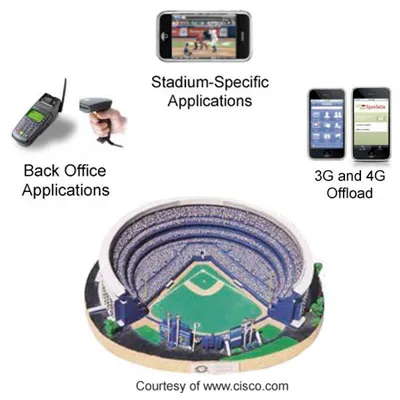
Many venues have begun to integrate crowd polls, live social media feeds, fan-generated content and interactive contests. Mobile apps take it one step further and allow fans to get personalized content, order drinks and get live updates.
These programs have a vital role to play.
They stay loyal to fans throughout natural breaks in play and continue to build a connection between fans, teams, and sponsors.
With all the attention being divided so widely, it is of utmost importance to keep it focused.
Entertainment Expectations Continue to Rise
Sport is no longer expected to take on an entire event.
A game at the stadium is more of an entertainment experience now.
This has driven a growth in demand for advanced stadium entertainment systems, which are able to handle complex productions.
Now, ceremonies before games are performed in a manner similar to that of concerts. The video, music, lights and special effects are all mixed together in the opening sequences. Player introductions are done with “choreography” in order to get the audience as excited as possible.
The lines between sports venue and entertainment venue slowly are beginning to get blurry.
In part, it's technology.
Business Benefits Extend Beyond the Fan Experience
Technology investments are often justified through fan engagement metrics, but the financial implications extend much further.
Many Stadium AV Solutions create valuable commercial opportunities.
Digital advertising inventory can be updated in real time and audience-specific. Sponsors gain access to more dynamic content formats, while venue operators generate additional revenue streams.
There are also premium seating areas with better technology. Guest corporate establishments are increasingly calling for complicated presentation systems, high quality displays and personal experiences.
These factors help to directly boost venue revenue and foster other venue business goals.
Looking Ahead
Innovation is underway in the next phase.
AI is starting to play a part in content delivery decisions. Event venues can gain more insights into their audience through data analytics platforms. There are new possibilities for fans to interact with events with augmented reality applications.
But new technologies for AV systems in modern sports stadiums are changing fast.
Personalized content experiences, adaptive audio environments, predictive maintenance systems and increasingly advanced digital interactions are possibilities for the future.
The technology itself will continue changing.
The purpose, though, is likely to stay the same.
Ensuring that events have an impact and provide a reason for fans to get out of the comfort of their own homes.
Conclusion
Live sports is no longer being transformed by just what goes on on the field, court, or track. More and more it is influenced by the competition's surroundings.
Whether it's bringing the whole crowd to life with Stadium Sound Systems or displaying information at sporting events with LED display systems, technology has become a major part of the modern fan experience.
In a world of ever-changing expectations, the stadiums and next-generation Sports Venue Technology that can leverage Immersive AV systems will be more likely to draw in viewers, foster loyalty and build memories.
The future of sports can still be the athletes' but the future of the stadium experience can also be the technologies that bring a moment to life.
 Media Pack Download
 Newsletters
 Industrial Events