
How Solar-Powered Stadiums Are Setting the Standard for Net-Zero Sports Venues
With the world barreling towards climate uncertainty, the place of the solar powered sports stadiums as the conveyor of sustainability is no longer of ornamental value – it has become the revolutionary act. When it comes to the future of sports architecture, these are not the only environmental and architectural giants redefining the way people experience the world of sport but also establishing powerful net zero stadium technology benchmarks. Soon we will have stadiums that will take the lead in the clean energy race, with photovoltaic sleek rooftops and state-of-the-art energy management systems. However, how is net zero emissions attained in practice in stadiums? The issue is whether in the future, can all stadiums also be powered by renewable energy. Now, it is time to dip into the wonderful universe of solar energy in sports venues and see how these are shaking up the game.
The Rise of Solar-Powered Sports Stadiums
The implementation of sports stadiums that rely on solar power has by far been a trend; it has actually been an earth-shaking phenomenon in the way sports stadiums are powered. As energy costs are rising to millions a year in an era when the carbon footprint is under more and more scrutiny, sports franchises are increasingly becoming preoccupied with sustainability initiatives just like governments as well. Enter solar power solutions for stadiums, which do not only guarantee sustainable energy consumption, but also brand promotion and lowering of costs in the long run.
However, what sports stadiums use solar power today? In Amsterdam, Johan Cruijff ArenA (previously Amsterdam ArenA) in the Netherlands and Levi Stadium, California amongst many other top-rank stadiums have already welcomed the sun. These trailblazers prove the viability and replicability of solar stadium design breakthroughs and other stadiums are more than willing to now follow in their footsteps.
How Stadiums Use Solar Power: A Technological Overview
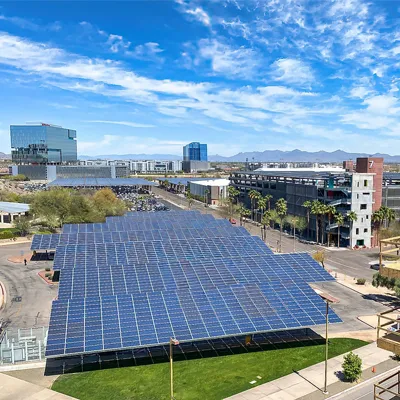
How solar power is practically utilized in stadiums? Let us unravel. The core of the metamorphosis is an installation of solar panels on sports stadium roofs which can include thousands of square meters. These panels trap the sunlight and use them in form of electricity either instantly or in the advanced battery systems later.
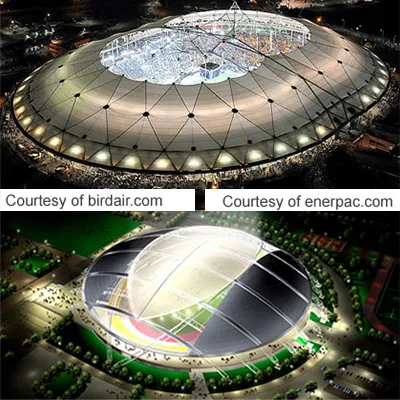
As a case in point, the Kaohsiung National Stadium in Taiwan has more than 8,800 solar panels, which produce 1 million kWh a year. The stadium is a prototype of new net zero stadium technology that can show how new stadiums can be operational and environmentally sound.
Solar Stadium Design Innovations: Beyond Panels
It is not only a rooftop story. The other zones of solar stadiums innovation design include passive ventilation, intelligent LED lamps and intelligent sources of energy management. As a combination, these factors decrease the energy burden level, and solar systems can fulfill a greater proportion of the demand. There are even stadiums that go beyond solar and incorporate green roofs and rainwater harvesting as well.
The Allianz Riviera in Nice, France, has been designed to maximize solar radiation and minimize energy loss. They have been very successful in the way they have incorporated aesthetics and functionality in coming up with high-impact solar power systems in stadiums, which attract both the environmentalists and the sports fans.
Market Snapshot: Where Are We Headed?
| Region | Notable Stadiums Using Solar Power | Key Solar Technologies Deployed |
| North America | Levi’s Stadium, Lincoln Financial Field | Photovoltaic panels, smart lighting, battery storage |
| Europe | Johan Cruijff ArenA, Allianz Arena | BIPV panels, energy dashboards, green roofs |
| Asia | Kaohsiung Stadium, Tokyo Olympic Stadium | Solar membranes, microgrids, passive cooling |
| Middle East | Al Janoub Stadium, Qatar | Desert-optimized panels, AI-based load balancing |
This market snapshot demonstrates the worldwide trend on implementing solar energy in sports venues and the concept that stadiums powered by renewable energy is no longer an assumption – it is already becoming a norm.
The Numbers Game: How Much Solar Power Does a Stadium Need?
The issue of what is the amount of solar that a stadium requires is an in-depth one and depends considerably on scale and format as well as working hours. A 50,000-seat stadium's energy needs may be met by just solar energy installation, which would require an average of 1.2 to 2 MW of solar power. But through battery storage and interaction with the grid, many venues will be able to stretch this efficiency to night games and special events.
Having more than 4,000 rooftop solar panels, it can make up to 1.6 million kWh of power so it is possible to play ten home games just upon the sunlight. This explains why the concept of solar powered sports stadiums is not only highly viable theoretically, but a success story.
Real-World Examples: Champions of the Solar Shift
Once again, the question appears: what sports stadiums use solar power, and what kinds of lessons can be learned?
1. Levi’s Stadium, California
It became one of the first to use the net zero stadium technology in balancing its energy consumption through solar and energy-efficient design.
2. Mercedes-Benz Stadium, Atlanta
An LEED-Platinum facility, it has the first stadium in the United States to install advanced solar power systems in stadiums and water conservation technologies.
3. Kaohsiung Stadium, Taiwan
This venue exclusively powered by solar energy is a clear answer to the question: can stadiums run entirely on renewable energy?
Such places are not just sports centers but also educational centers since it offers insight to people how stadiums operate using solar energy and create a strong sense of awareness among people living in the community about power of renewable resources.
How Do Stadiums Achieve Net Zero Emissions?
It is much more than installing solar panels to become net zero in its emissions. The method entails a stratified plan:
Energy Generation: The introduction of solar panels on sports stadium roofs; the incorporation of other renewable energy sources.
Energy Efficiency: Illuminate the upgrade lighting system, HVAC systems, and control smart monitoring of energy utilization.
Carbon Offsetting: Reputable offset programs make up for whatever emissions that remain.
Shortly put, how do stadiums reach the condition of net zero-emission? Through its redesign of each watt used and each carbon ton produced. Such facilities act as models to bigger urban sustainability initiatives.
A Look Ahead: What's Next for Solar Powered Sports Stadiums?
It remains a possibility that the generation of solar powered sports stadiums will represent nothing less than a self-sustainable ecosystem owing to the rapid development of photovoltaics and AI-based energy management. We are encountering breakthroughs in skins on the solar panels, seats generating energy, clear panes due to which natural lighting is provided and at the same time, solar energy is also generated.
In addition, new technology, such as solar energy in sports venues coupled with other innovations like kinetic flooring and geothermal cooling is beginning to blur the border between architecture and sustainability. It is not whether stadiums can run entirely on renewable energy is the question, but how can it be done in the most creative way possible?
Beyond Energy: Social and Economic Impacts
The influence of solar energy in sports venues goes much more than the environment. Economically, these stadiums save a lot of operating expenses and in some cases, sell excess power to the grid, forming a new source of income.
On a social front, they succeed in popularizing the idea of sustainability among the fans and every match becomes a point of educating the fans on climate responsibility.
Other franchises are even converting their solar roofs to community properties. As an example, such places can during off-season periods or even energy crises provide electricity to the local neighborhoods. It indicates that the innovations of solar stadium design can go beyond the field of sports and become one of the foundations of urban resilience.
Conclusion: A New Era for Sports Infrastructure
With the race gathering pace to achieve carbon neutrality by 2030, the solar powered sports stadiums are no longer viewed as an oddity – it is now becoming the rule of thumb. They provide persuasive answers to certain questions like how stadiums can become net-zero, and how much solar power can a stadium accommodate as well as make sure that the utilization of solar power solutions in stadiums is not only imaginable, but radical.
The dilemma is no more technology but the desire to use it. As the expenses of solar energy drop off and consciousness increases, now is the most appropriate time to invest in the solar electricity system in stadiums. Naturally, it is not just a game which the fans watch but the future.
And the next sun-powered stadium to achieve championship sustainability will be your favorite? The light of the future technology of the net zero stadium has already revealed itself – and it is bright in the sunlight.
 Media Pack Download
 Newsletters
 Industrial Events