
Choosing the Right Sports Flooring: Safety, Durability, and Performance Factors
Most sports injuries don't happen because of bad technique or bad luck — they happen because of what's underneath the athlete's feet. A floor with too little cushioning, poor grip, or inconsistent bounce can undo months of training in a single wrong step. Yet flooring is often the last thing anyone thinks about when planning a gym, court, or training facility, treated as a background detail rather than the piece of equipment it actually is. Choosing the right sports flooring is one of those decisions that looks simple on paper and gets complicated fast once you start digging into the details.
Whether you're outfitting a school gymnasium, a community sports complex, a home fitness studio, or an outdoor multi-use court, the flooring you pick will shape safety outcomes, long-term maintenance costs, and how well athletes actually perform on it. This guide breaks down what really matters when evaluating athletic flooring, so you can make a decision that holds up for years, not just for the first season.
Why Sports Flooring Deserves More Attention Than It Gets
Most people assume flooring is a cosmetic or budget-line decision — pick something that looks decent, fits the budget, and move on. That mindset causes more injuries and more replacement costs than almost any other facility mistake.
The right sports surfaces do three jobs at once: they protect the people using them, they survive years of heavy, repetitive use, and they support the specific movements each sport demands. Get any one of those wrong, and the consequences show up quickly — whether that's a rise in ankle injuries, a floor that buckles after two winters, or players complaining that the surface feels "dead" underfoot.
Safety: The Non-Negotiable Factor
When people search for choosing the right sports flooring for safety, they're usually reacting to a real problem — an injury, a near-miss, or a facility that's aging out of compliance. Safety in sports flooring comes down to a few measurable qualities.
Shock absorption is the big one. A good athletic floor reduces the impact force transmitted back into a player's joints during running, jumping, and landing. This matters enormously for basketball, volleyball, and gymnastics, where repetitive high-impact movement is constant. Flooring with poor shock absorption contributes to chronic joint stress over time, even if it doesn't cause an obvious acute injury.
Slip resistance is the second pillar. Traction needs to be balanced carefully — too little grip and players slide unpredictably; too much and shoes can catch, twisting knees and ankles. The best systems are engineered to offer consistent, predictable friction across the entire surface, in both dry and slightly sweaty conditions.
Ball response and surface uniformity also tie into safety, oddly enough. An inconsistent surface, where the ball bounces differently in one spot than another, forces players to adjust their footing unpredictably, which raises injury risk over a season of play.
Finally, cushioning systems that meet recognized athletic flooring standards (such as those used in professional basketball or volleyball courts) are built with layered shock pads, not just a decorative top layer. That layered construction is what actually separates a safe floor from a merely attractive one.
Durability: Built for the Long Game
Durability is where a lot of facilities get burned financially. A cheaper floor might save money upfront but demand replacement in five years, while a well-built one lasts fifteen or twenty. When evaluating durable sports flooring materials, a few things separate the floors that last from the ones that don't.
Wear resistance matters most in high-traffic zones — free-throw lines, sidelines, entry points. Materials need to resist abrasion from constant foot traffic, equipment rolling across them, and, in some cases, folding chairs or bleachers being set up and taken down repeatedly.
Moisture and temperature tolerance is critical, especially for facilities that see seasonal humidity swings or outdoor exposure. Flooring that expands, contracts, or warps with temperature changes will eventually develop gaps, bubbles, or cracks — all of which become both a maintenance headache and a safety hazard.
Maintenance requirements also factor into real-world durability. A floor that requires specialized cleaning products, frequent recoating, or delicate handling will degrade faster in a facility that doesn't have the staff or budget to maintain it properly. The most durable options tend to be the ones that tolerate normal cleaning routines without losing their protective properties.
Performance: How the Floor Affects the Game
This is the factor most often overlooked by facility managers focused purely on cost and safety compliance — but athletes notice it immediately. Sports flooring materials that improve safety, durability, and player performance share a common trait: they're tuned to the specific demands of the sport being played on them.
Energy return is a major performance variable. A floor with too little give feels harsh and tiring over long sessions; one with too much give absorbs an athlete's energy instead of returning it, slowing them down. Basketball courts, for instance, are engineered for a specific balance of cushioning and responsiveness so players can jump repeatedly without excessive fatigue.
Ball bounce consistency matters just as much. Basketball and volleyball both rely on predictable rebound behavior. A flooring system with inconsistent bounce response — often caused by uneven subfloor preparation or low-quality materials — throws off shooting accuracy and passing precision in ways players feel immediately, even if they can't articulate why.
Surface texture and grip round out the performance picture. Sprinters need a different grip profile than volleyball players diving for a dig. Weight rooms need flooring that stays stable under dropped equipment without shifting. This is why generic, one-size-fits-all flooring rarely performs well across multiple sports — purpose-built sports flooring solutions are engineered around the specific biomechanics of the activity.
Comparing Common Sports Flooring Materials
There's no single "best" material — the right choice depends on the sport, the setting, and the budget. Here's a general breakdown:
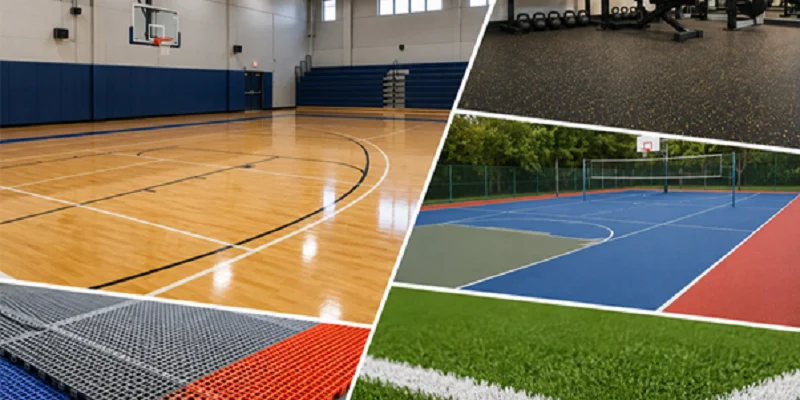
- Hardwood (maple): The traditional choice for basketball and volleyball courts. Excellent ball response and performance feel, but requires significant maintenance and is vulnerable to moisture damage, making it a poor fit for humid or outdoor environments.
- Vulcanized rubber: Known for exceptional durability and shock absorption. Common in multi-purpose gyms, weight rooms, and high-traffic training facilities. Handles heavy equipment well and resists wear better than most alternatives.
- Polyurethane (PU) systems: Popular for indoor courts needing a balance of cushioning, seamless surfacing, and consistent ball bounce. Often used in professional and semi-professional facilities where performance consistency is critical.
- Modular sports tiles: Interlocking tiles made from PVC or polypropylene, widely used for both indoor and outdoor courts. They're relatively easy to install, replace individual damaged sections, and adapt well to temperature swings — a strong option for facilities weighing best sports flooring solutions for indoor and outdoor use.
- Synthetic turf systems: Standard for outdoor multi-sport fields, offering weather resistance and low maintenance, though performance characteristics vary widely based on infill type and pile height.
Each of these can be considered part of a broader category of high-performance athletic flooring systems, but the "high-performance" label only holds up when the material is matched correctly to its intended use.
Indoor vs. Outdoor: Different Rules Apply
Indoor and outdoor flooring decisions aren't interchangeable, even when the sport is the same. Indoor surfaces can prioritize ball response and controlled cushioning because they aren't exposed to weather extremes. Outdoor surfaces need to prioritize UV resistance, drainage, and temperature stability first — a beautiful indoor-grade floor installed outside will likely fail within a season or two.
Facilities managing both environments often end up choosing different material families entirely: hardwood or PU indoors, modular tiles or synthetic turf outdoors. Trying to force one material to do both jobs is one of the most common and costly mistakes in facility planning.
How to Actually Make the Decision
A practical approach to choosing sports flooring usually comes down to answering four questions honestly:
- What sport(s) will primarily use this space? Multi-purpose facilities need flooring that compromises intelligently across sports, not flooring optimized for just one.
- What's the expected traffic level? A recreational community center and a competitive training facility have very different wear profiles.
- What's the climate and installation environment? Indoor, outdoor, humid, dry — each pushes the decision toward different materials.
- What's the realistic maintenance budget? The most durable floor in the world underperforms if nobody's maintaining it correctly.
Answering these questions first — before comparing brands or price tags — keeps the decision grounded in actual facility needs rather than marketing claims.
Frequently Asked Questions
What is the safest type of sports flooring?
Flooring systems with layered shock-absorbing pads, such as rubber or engineered PU systems, generally offer the best combination of impact protection and consistent traction, making them a strong choice where injury prevention is the top priority.
How long does sports flooring typically last?
With proper maintenance, hardwood floors can last 20–30 years, rubber and PU systems typically last 10–20 years, and modular tiles usually last 10–15 years, depending on traffic and climate exposure.
Is rubber or hardwood better for a multi-purpose gym?
Rubber flooring generally performs better in multi-purpose gyms because it tolerates heavier equipment, higher traffic, and varied activities without the maintenance sensitivity that hardwood requires.
Can the same flooring be used indoors and outdoors?
Not reliably. Indoor flooring materials usually lack the UV resistance and drainage properties needed outdoors, while outdoor-rated materials often sacrifice the ball-response precision needed for indoor competitive play.
Final Thoughts
Choosing sports flooring isn't really about finding the flashiest option — it's about matching material science to real-world demands: how hard people will land on it, how many years it needs to survive, and how the ball needs to behave on it. Facilities that treat flooring as a serious engineering decision, rather than an afterthought, end up with safer athletes, lower long-term costs, and a surface that actually performs the way it's supposed to — season after season.
 Media Pack Download
 Newsletters
 Industrial Events