
Why Maple Wood Remains the Gold Standard for Indoor Sports Courts
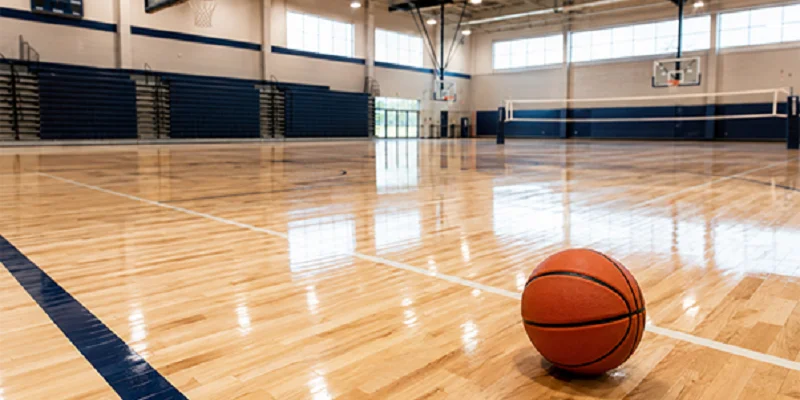
Ask any architect, athletic director, or flooring contractor what material belongs on a serious indoor court, and the answer comes back almost instantly: maple. From the NBA to neighborhood recreation centers, maple wood sports flooring has remained the default choice for generations, even as newer synthetic and composite products have entered the market promising lower costs and easier installation. That staying power isn't an accident of tradition — it's the outcome of maple consistently outperforming alternatives on the things that matter most: durability, safety, and game-day performance.
In this article, we'll break down exactly why hardwood sports flooring, and maple in particular, has held its position at the top for over a century, and why facility owners, architects, and athletic directors continue to choose it above every competing material.
What Makes Maple the Preferred Choice for Indoor Sports Courts?
Indoor sports courts demand a flooring material that can handle constant, high-impact use while protecting the athletes who play on it. Basketball, volleyball, badminton, gymnastics, and indoor tennis all place different but equally demanding stresses on a playing surface — rapid lateral movement, jumping, sliding, and repeated pounding from running feet.
Maple wood has risen to meet these demands because of its unique physical properties:
- Exceptional hardness and density: Maple is a tight-grained hardwood that resists denting, scratching, and surface wear far better than softer wood species like pine or fir.
- Natural shock absorption: Maple's cellular structure allows it to flex slightly under impact, reducing stress on joints, ankles, and knees during high-intensity play.
- Consistent, light-colored surface: Maple's pale, uniform coloring makes it easy to see ball movement and court markings clearly, which is why it's the standard in televised sporting events.
- Smooth, tight grain: This minimizes splintering and creates an even surface that supports predictable ball bounce and consistent footing.
These qualities combine to create a surface that performs consistently game after game, season after season — something synthetic alternatives still struggle to replicate at the same level.
The Engineering behind Maple Wood Athletic Flooring
A common misconception is that a maple court is simply planks of wood nailed to a subfloor. In reality, modern maple wood athletic flooring is part of a highly engineered system designed specifically for sports performance.
Layered Construction for Performance
Most professional-grade indoor sports court flooring systems consist of multiple layers working together:
- Subfloor or slab base – typically concrete, providing structural stability.
- Resilient underlayment or sleeper system – foam pads, rubber pads, or wood sleepers that absorb shock and create controlled give.
- Plywood subfloor layer – adds rigidity and distributes weight evenly across the surface.
- Maple wood top layer – the visible, playable surface, typically 25/32" thick tongue-and-groove maple strips.
- Finish coating – a sealed, game-ready surface that provides the correct friction coefficient for athletic footwear.
This layered approach is what allows maple courts to meet strict performance standards set by organizations like the National Basketball Association (NBA), NCAA, and international sports federations, particularly around shock absorption, ball bounce consistency, and surface friction.
Engineered vs. Solid Maple Systems
Facilities today typically choose between two primary systems:
- Solid maple strip flooring, fastened directly over a sleeper or subfloor system, offering maximum durability and a traditional look and feel.
- Engineered maple flooring, which uses a thinner maple veneer bonded to a stable plywood core, offering easier installation, reduced material cost, and strong resistance to humidity-related movement.
Both options fall under the umbrella of trusted maple sports flooring solutions, and the right choice generally depends on budget, subfloor conditions, and the intended level of competitive use.
Durability: Built for Decades of High-Impact Use
One of the biggest reasons facility managers continue to invest in maple is simple: it lasts. Durable maple flooring for indoor sports courts can remain in service for 30 to 50 years when properly installed and maintained — a lifespan that few other flooring materials can match under similarly heavy use.
Maple's density gives it a natural resistance to the kind of wear patterns that develop on high-traffic courts, such as:
- Scuffing from rubber-soled athletic shoes
- Impact marks from dropped equipment
- Surface compression from repeated jumping and pivoting
- Wear along frequently used lanes, such as free-throw areas or service lines
Because maple can be sanded and refinished multiple times over its life, facilities can restore a worn court to like-new condition without the cost of a full replacement. This refinishing capability alone gives maple a long-term cost advantage over synthetic and composite flooring, which typically cannot be restored once damaged and must be replaced entirely.
Player Safety: Why Maple Still Leads in Shock Absorption
Athlete safety is arguably the single most important factor driving the continued dominance of hardwood flooring for sports facilities. Repeated impact on an overly rigid surface increases the risk of stress injuries, while an overly soft surface can compromise stability and increase the risk of ankle rolls or falls.
Maple flooring systems are engineered to strike the ideal balance through what's known as controlled deflection — the floor gives slightly under impact and then returns to its original position, absorbing shock without sacrificing stability. This is measured through standardized tests for:
- Force reduction – how much impact shock is absorbed rather than transferred to the athlete's joints
- Vertical deformation – how much the surface compresses under load
- Ball bounce consistency – ensuring uniform bounce across the entire court
Maple systems consistently meet or exceed international performance benchmarks (such as those set by DIN and FIBA), which is a major reason they remain the preferred surface for professional and competitive-level facilities.
Benefits of Maple Wood Flooring for Indoor Sports Facilities
To summarize the core advantages that keep maple at the top of facility managers' and architects' lists, here are the benefits of maple wood flooring for indoor sports facilities:
- Superior durability — withstands decades of heavy athletic use
- Refinishable surface — sanded and resealed instead of replaced
- Excellent shock absorption — reduces injury risk for athletes
- Consistent ball response — critical for basketball and volleyball
- Aesthetic appeal — bright, uniform tone enhances visibility and broadcast quality
- High resale and facility value — maple courts are seen as a premium standard
- Compliance with athletic standards — meets NBA, NCAA, and international regulations
- Environmentally sustainable — maple is a renewable resource, and refinishing extends usable life, reducing landfill waste compared to synthetic alternatives
Maple vs. Synthetic and Composite Flooring
Synthetic sports flooring has improved significantly, and it does offer benefits in specific use cases — lower upfront cost, easier installation, and better moisture resistance in some environments. However, when compared directly, maple wood flooring for sports courts still outperforms synthetics in the areas that matter most for competitive and long-term use:
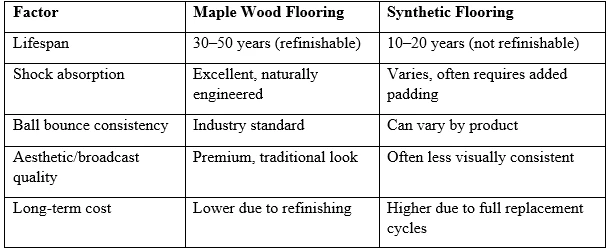
For facilities aiming for competitive-level play, professional certification, or long-term value, maple remains the clear choice.
Installation and Maintenance Considerations
Proper installation is essential to getting the full performance and lifespan benefits of a maple court. Facilities should work with experienced flooring contractors who understand:
- Correct subfloor preparation and moisture testing
- Proper acclimation of maple wood to the facility's humidity and temperature
- Accurate sleeper or underlayment spacing for optimal shock absorption
- Sealing and finish application suited to the sport being played
Ongoing maintenance is relatively straightforward compared to other flooring types. Routine dust mopping
Frequently Asked Questions
Why is maple wood used for basketball courts instead of other woods?
Maple is denser, harder, and has a tighter grain than most other hardwoods, giving it superior resistance to wear, better shock absorption, and a smoother, more consistent playing surface.
How long does maple sports flooring typically last?
With periodic deep cleaning with pH-balanced cleaners, and scheduled recoating (rather than full refinishing) every few years keep a maple court performing at its best.Frequently Asple wood used for basketball courts instead of other woods?
Maple is denser, harder, and has a tighter grain than most other hardwoods, giving it superior resistance to wear, better shock absorption, and a smoother, more consistent playing surface.
How long does maple sports flooring typically last?
With proper installation and maintenance, maple sports flooring can last 30 to 50 years, especially since it can be sanded and refinished multiple times rather than replaced.
Is maple flooring better than synthetic flooring for indoor sports courts?
For competitive and long-term use, maple generally outperforms synthetic flooring in durability, shock absorption, ball bounce consistency, and long-term cost, though synthetics may suit lower-budget or temporary installations.
What makes maple wood flooring safe for athletes?
Maple's engineered flooring systems provide controlled deflection, meaning the surface absorbs impact and reduces stress on athletes' joints while still maintaining the stability needed for quick movements.
Can maple sports flooring be repaired if damaged?
Yes. Because maple is a solid hardwood, damaged areas can often be sanded, patched, or refinished, extending the floor's life without requiring full replacement.
Final Thoughts
The continued popularity of maple wood flooring for sports courts isn't a coincidence — it's the result of decades of proven performance across every level of competitive athletics. From its natural durability and shock absorption to its refinishable surface and long-term cost efficiency, maple offers a combination of benefits that synthetic and composite alternatives still haven't fully matched.
For architects, facility owners, and athletic directors evaluating indoor sports court flooring systems, maple remains the benchmark against which every other option is measured — and for good reason. When performance, safety, and longevity matter most, maple wood continues to earn its place as the gold standard for indoor sports courts.
 Media Pack Download
 Newsletters
 Industrial Events