

The Rise of Hybrid Turf: Redefining Performance in Professional Sports
Introduction: A New Playing Surface for a New Era of Sport
The development of professional sports is going at an all-time high rate. Stadiums are no longer mere places but are high-performance spaces, where the primary goal is to ensure maximum output of athletes, fans, quality broadcasts and commercialization. The playing surface is one of the most important and very much neglected elements of this evolution. The more the congestion of fixtures, the more unpredictable the weather patterns and the more expectations on the safety of the players, the more the traditional natural grass cannot cope with the new demands. This has boosted the development of hybrid turf system in the world and has made hybrid sports turf to become a strategic investment decision but not a maintenance option.
In the modern stadiums of football, rugby, cricket, American football, multi-purpose arena, and other sports, modern hybrid grass technology is redefining the sense of performance, durability and sustainability.
What Is a Hybrid Turf System in Sports?
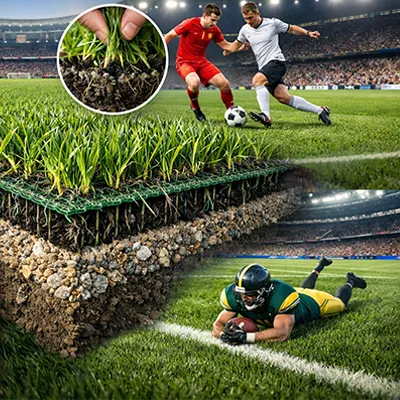
In sports, a hybrid turf system is a reinforced surface made of reinforced fibers of synthetic materials in addition to natural grass in order to form a surface that does not lose the biological properties of grass but considerably increases the stability of the structure. As opposed to artificial turf, hybrid turf systems leave alive grass roots, which is supported by stitched, woven or injected synthetic fibers into the root zone.
These fibers normally make up a small percentage of the surface type, yet contributes a disproportionately large part aiding to strengthen the root structure, enhance the shear strength, and mitigate divots. The outcome is a mixture of sports turf that acts like natural grass on the ground and works like a high-technology surface when stressed.
As far as the technology of operations in a stadium is concerned, this technology will overcome the long-term gap in terms of the quality of performance and the durability of surfaces.
Why Stadiums Are Switching to Hybrid Turf
The trend of the hybrid turf is also coming due to the operational realities, not due to aesthetic preference. Never has modern stadiums hosted as many matches, non-sporting events and a broadcast-based scheduling as it is currently. Natural grass cannot withstand compressed recovery time particularly in fronts of goal, scrums, and in the middle of the field.
Compared to other turf systems, hybrid turf systems have short recovery time, increased wear resistance and season long playability. This has made them especially appealing to stadiums that have two consecutive matches, international tournaments, and multi-sport programmes.
Moreover, climate volatility has been rendering the upkeep of pure natural grass even costlier. Hybrid turf will reduce the effects of heavy rain, drought stress, and extreme temperatures providing year-long reliability of surface usage, which grounds managers and stadium owners find attractive.
Hybrid Turf vs Natural Grass Comparison
The commercial and performance case of the hybrid turf is only possible through a direct comparison with the traditional natural grass.
| Parameter | Natural Grass | Hybrid Turf Systems |
| Durability under heavy use | Moderate | High |
| Recovery time between matches | Longer | Significantly shorter |
| Player traction and stability | Variable | Consistent |
| Maintenance intensity | High | Optimized and predictable |
| Suitability for multi-use stadiums | Limited | Excellent |
| Lifecycle cost efficiency | Lower upfront, higher long-term | Higher upfront, better long-term ROI |
The following comparison of hybrid turf and natural grass underlines the reason why high-end facilities are increasingly considering surface technology as a long-term investment in infrastructure over an annual maintenance cost.
How Hybrid Turf Improves Player Performance
A direct effect on performance of athletes is one of the strongest arguments of hybrid turf. The performance of players depends on the playing surface in terms of speed, balance, fatigue and risk of injury, which makes the choice of turf an important performance issue.
Hybrid sports turf will offer greater uniform traction leading to the decrease of slippage without the increase of joint stress. This consistency will enable players to make more confidence with accelerating, decelerating and turning. This is because the reinforced root zone reduces the surface deformation as well and the ball roll and bounce can be predicted meaning that it is especially significant in sports like football and cricket.
In the context of sports science, the way in which hybrid turf enhances the performance of players is the fact that it allows to balance hardness and shock absorption. The number of micro-adjustments athletes undergo in the field reduces, and the efficiency of movement and muscular fatigue in a game decrease.
Benefits of Hybrid Turf for Stadiums beyond the Pitch
Although the performance of players is one of the factors, the advantages of hybrid turf on stadiums are way beyond the results of matches. Efficiency in operations, brand name, and commercial use are all aspects used in adoption decisions.
The hybrid turf systems decrease the number of times a pitch and emergency repairs are done and consequently this results in predictable maintenance timetables. This has made it possible to hold more events in stadiums without affecting the quality of the surfaces, which makes them more profitable.
Sponsors and broadcasters also have the advantage of high quality images at all times. The spotless pitch strengthens brand recognition particularly in televised international events where the appearance of surfaces can adversely affect the viewer experience.
To the owners of the stadiums hybrid turf acts as a point of intersection between performance engineering and asset optimization.
Hybrid Grass Technology in Modern Stadiums
The technology of hybrid grass in contemporary stadiums has advanced very fast in the past ten years. The old systems were mainly based on the concept of reinforcement and current solutions are based on the idea of advanced drainage with an added touch of sub-base engineering and computer-guided maintenance methods.
Numerous professional facilities have installed hybrid turf systems that are enabled with sensor technology to track the moisture, compaction and root health in real time. Such a data-driven strategy allows ground teams to implement precise interventions, which would increase the lifespan of the surface and make the most out of the resources.
The adoption of hybrid turf and smart stadium infrastructure is indicative of a wider trend of high-level management of sports facilities, where all operations are made based on information.
Best Turf Systems for Professional Sports: A Strategic Selection
The choice of the most suitable turf systems in professional sports is based on their requirements by sports, weather, and intensity of use. Football and Rugby focus on the shear strength and recovery rate, and cricket focuses on the ball behaviour and surface quality. Multi-purpose stadiums need adjustable systems to tolerate the regular changes.
The latter can only be successful when turf engineers, agronomists, architects, and stadium operators combine their efforts to create hybrid turf systems that will be adaptable. The best installations view hybrid turf as an integrated ecosystem and not as an independent surface.
This strategic plan will make sure the performance of turf is not a fix on a short-term basis, but one with long-term goals of the venue.
Sustainability and Lifecycle Economics of Hybrid Turf Systems
The concept of sustainability is becoming a more influential factor in the procurement process of the infrastructure of professional sports. Hybrid turf systems are helping in achieving environmental objectives in terms of water use, reduction of chemical application and increasing the lifecycle of the pitch.
Although the initial installation is more expensive than natural grass, the lifecycle analysis has shown to have less total cost of ownership. Lower re-turfing rates, decrease in match cancellations, and maximized maintenance inputs help in economic efficiency in the long term.
The hybrid turf provides a nice compromise between environmentally-conscious and commercially viable operations to the stadium operators that are dealing with constrained budgets and the requirement to be environmentally friendly.
Industry Outlook: Hybrid Turf as the New Standard
The world sports turf market is at a crossroad. Hybrid sports turf is no longer considered to be a ground of innovation, it is now an anticipated experience, as the level of performance expectation increases and demand escalates on the operational side. Even major stadiums consider hybrid turf systems as an infrastructure, just like lighting, drainage or seating.
The threat of substitutes is low as well, since emerging markets are also implementing the hybrid grass technology as they invest in the international standard venues and this further boosts the world demand. This makes hybrid turf not only a solution of surface, but a sign of professionalization in the sport infrastructure.
Quick Industry FAQ: Hybrid Turf in Professional Sports
Is hybrid turf artificial grass?
Hybrid turf is not unnatural turf. It is a natural grass with synthetic fibers, which maintain the biological growth and also increase its durability.
Does hybrid turf increase injury risk?
Research and professional use suggests that hybrid turf offers a reliable level of traction and shock absorption that allows the players to be safe as long as installed and properly maintained.
Can hybrid turf be used in multi-sport stadiums?
Yes. Multi-use turfs are the most appropriate ones to be used because of quicker recovery and increased wear resistance.
Conclusion: The Future beneath the Game
The emergence of the hybrid turf is the first major change in the attitude of professional sports towards performance surfaces. The turf technology has found its way to the crossroads of athlete wellbeing, operational effectiveness and business approach, and it is no longer limited to groundskeeping discourse.
Hybrid turf systems are a compromise, compromising both natural grass functionality and completely synthetic turfs, yet they provide a compromise, a solution that is ready for the future. Following the current development of stadiums into high-performance platforms, hybrid sports turf is on the verge of becoming the new standard in the industry, as it will not only change the nature of the playing field, but also define what elite performance really looks like.
 Media Pack Download
 Newsletters
 Industrial Events