
Smart Maintenance in Sports Venues: Robotics, IoT and Hygiene Standards
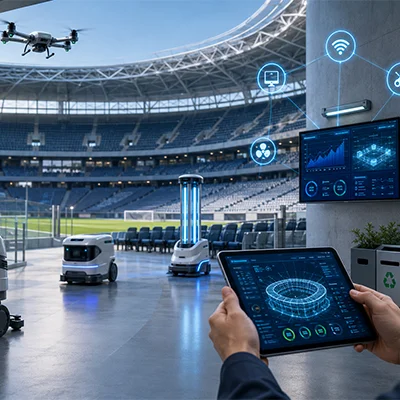
Modern sports venues have evolved into sophisticated entertainment destinations that host thousands of spectators, multiple events, concerts, corporate gatherings, and community activities throughout the year. As expectations for visitor experience continue to rise, maintaining these facilities has become significantly more complex than traditional stadium operations. Today's venue operators are expected to deliver impeccable cleanliness, uninterrupted operations, energy efficiency, and rapid turnaround between events—all while controlling operational costs.
This growing demand has accelerated the adoption of Smart Sports Venue Maintenance, where connected technologies, intelligent automation, robotics, and predictive analytics work together to redefine facility operations. Rather than relying solely on manual inspections and reactive repairs, stadium operators are increasingly implementing digital ecosystems capable of identifying maintenance requirements before failures occur.
From autonomous cleaning robots patrolling concourses to sensors monitoring HVAC systems and structural health in real time, technology is enabling a proactive approach to Stadium Maintenance. Combined with advanced analytics, these solutions enhance safety, extend infrastructure lifespan, reduce downtime, and improve sustainability.
As global sporting events continue to attract larger audiences, Sports Facility Management is entering an era where data-driven maintenance is no longer a competitive advantage—it is becoming an operational necessity.
The Growing Complexity of Stadium Operations
A modern sports venue functions much like a small smart city.
Within a single facility, operators must manage:
- Seating areas
- Playing surfaces
- Lighting infrastructure
- HVAC systems
- Elevators and escalators
- Electrical distribution
- Water management
- Digital scoreboards
- Security systems
- Food courts
- Restrooms
- Parking facilities
- Waste management
Every one of these systems requires continuous monitoring and scheduled servicing.
Traditional maintenance approaches typically involve periodic inspections or reactive repairs after equipment failures occur. While these methods were adequate in the past, they often result in:
- Unexpected equipment downtime
- Higher repair costs
- Increased energy consumption
- Poor visitor experiences
- Event disruptions
- Shortened equipment lifespan
The emergence of IoT Stadium Solutions enables operators to monitor every critical asset continuously instead of relying on fixed maintenance schedules.
Why Smart Maintenance is Becoming Essential
Today's sports venues rarely remain idle.
Many stadiums now host:
- Professional sporting events
- Concerts
- Esports tournaments
- Corporate events
- Community festivals
- Exhibition shows
This continuous utilization leaves limited time for inspection and maintenance.
Consequently, operators require smart maintenance solutions for sports venues that automate routine tasks while providing real-time operational intelligence.
Smart maintenance focuses on four key objectives:
- Predict failures before they happen
- Reduce manual inspection requirements
- Improve operational efficiency
- Maintain consistent hygiene and safety standards
Instead of repairing broken systems, facilities can prevent failures altogether.
IoT is Transforming Stadium Maintenance
Connected sensors now form the backbone of modern IoT-enabled venue maintenance systems.
Thousands of IoT devices installed across a stadium collect operational data every second.
Typical monitored assets include:
- HVAC equipment
- Escalators
- Elevators
- Pumps
- Water systems
- Electrical panels
- Emergency generators
- Lighting fixtures
- Refrigeration systems
- Roof structures
Sensors continuously measure:
- Temperature
- Humidity
- Vibration
- Pressure
- Power consumption
- Water flow
- Equipment runtime
- Structural movement
This data flows into centralized dashboards where facility managers gain complete visibility across the venue.
Instead of waiting for complaints or breakdowns, maintenance teams receive automated alerts whenever abnormal operating conditions emerge.
Predictive Maintenance Changes Everything
One of the biggest innovations in Sports Facility Management is predictive maintenance.
Rather than servicing equipment based on calendar schedules, maintenance occurs only when operational data indicates that intervention is required.
For example:
A motor driving an escalator may normally vibrate within a predefined range.
If vibration sensors detect increasing oscillations over several weeks, predictive algorithms recognize early signs of bearing wear.
Maintenance teams receive an alert weeks before failure occurs.
Repairs can then be scheduled during non-event hours without affecting visitors.
This approach dramatically reduces:
- Emergency repairs
- Equipment failures
- Operational interruptions
- Spare parts inventory
- Maintenance costs
Today, many facility operators are implementing Predictive maintenance for sports venues to maximize asset availability while optimizing maintenance budgets.
Robotics is Revolutionizing Facility Operations
Large sports venues contain enormous floor areas requiring daily cleaning.
Traditional manual cleaning demands extensive labor while maintaining consistent quality can be difficult during high visitor traffic.
This challenge has accelerated adoption of Robotics for stadium facility management.
Autonomous robots now perform numerous repetitive maintenance activities.
Examples include:
Autonomous Floor Cleaning
Robotic scrubbers clean:
- Stadium concourses
- VIP lounges
- Food courts
- Corridors
- Exhibition halls
Using LiDAR navigation and AI mapping, robots avoid obstacles while maintaining optimal cleaning routes.
Robotic Vacuum Systems
Large carpeted areas inside premium hospitality zones can be vacuumed automatically overnight.
Cleaning reports verify completed coverage.
UV-C Disinfection Robots
Following major sporting events, autonomous robots equipped with UV-C technology disinfect:
- Locker rooms
- Medical facilities
- Restrooms
- Hospitality suites
These systems improve hygiene while reducing dependence on chemical disinfectants.
Window and Glass Cleaning Robots
Many stadiums feature expansive glass façades that traditionally require specialized labor.
Robotic cleaning systems safely maintain exterior glass surfaces while reducing operational risks.
Hygiene Standards Have Become a Strategic Priority
The global emphasis on public health has permanently changed expectations surrounding venue cleanliness.
Visitors now expect visibly clean environments alongside scientifically managed sanitation practices.
Modern Smart Sports Venue Maintenance programs therefore integrate hygiene monitoring into overall facility management.
Smart hygiene systems include:
Smart Restroom Monitoring
IoT sensors monitor:
- Soap levels
- Tissue availability
- Occupancy
- Odor levels
- Water usage
- Cleaning frequency
Housekeeping teams receive alerts before supplies run out.
Air Quality Monitoring
Indoor environmental sensors continuously track:
- CO₂ concentration
- Temperature
- Humidity
- Airborne particles
HVAC systems automatically adjust ventilation based on occupancy.
Waste Bin Monitoring
Smart bins detect fill levels and optimize collection routes.
Cleaning staff no longer need to inspect every waste station manually.
Digital Cleaning Logs
Mobile workforce applications document:
- Cleaning times
- Personnel
- Inspection reports
- Sanitization records
These digital records simplify compliance audits while improving accountability.
Artificial Intelligence Enhances Maintenance Decisions
Collecting data alone is insufficient.
Artificial Intelligence transforms operational information into actionable recommendations.
AI platforms analyze years of maintenance history alongside live sensor data to identify emerging patterns.
Examples include:
- Predicting HVAC component failures
- Detecting abnormal energy usage
- Forecasting restroom cleaning demand
- Optimizing staffing levels
- Identifying recurring equipment issues
Instead of overwhelming facility managers with raw sensor readings, AI prioritizes maintenance activities according to operational risk.
Digital Twins Improve Maintenance Planning
Many newly constructed venues are adopting digital twin technology.
A digital twin is a virtual representation of the physical stadium.
Every connected asset continuously updates its digital counterpart using real-time operational data.
Facility managers can:
- Visualize equipment health
- Simulate maintenance activities
- Evaluate infrastructure upgrades
- Monitor asset performance remotely
Digital twins significantly improve long-term infrastructure planning while reducing maintenance uncertainty.
Sustainability and Maintenance Now Go Hand in Hand
Efficient maintenance also supports environmental sustainability.
Properly maintained equipment consumes less energy, produces fewer emissions, and operates longer before replacement.
Smart maintenance systems help optimize:
- HVAC energy consumption
- Lighting schedules
- Water distribution
- Irrigation systems
- Waste management
- Equipment lifecycle
Leak detection sensors identify water losses immediately, while smart lighting systems automatically adjust based on occupancy and daylight availability.
These initiatives reduce operational expenses while supporting ESG objectives.
Workforce Transformation through Connected Technologies
Technology is not replacing maintenance professionals—it is empowering them.
Technicians now use mobile applications providing:
- Equipment history
- Maintenance manuals
- Digital work orders
- Asset location
- Real-time sensor readings
Instead of spending hours locating problems, technicians arrive equipped with accurate diagnostic information.
Remote experts can even assist field technicians through augmented reality, reducing repair times and improving first-time fix rates.
This collaborative approach increases workforce productivity while improving maintenance quality.
Cybersecurity Cannot Be Overlooked
As more assets become connected through IoT Stadium Solutions, cybersecurity becomes increasingly important.
Smart maintenance systems now manage mission-critical infrastructure including:
- Electrical systems
- Access control
- HVAC operations
- Fire safety
- Building automation
Any cyberattack targeting these systems could disrupt major sporting events.
Consequently, facility operators are investing in:
- Network segmentation
- Multi-factor authentication
- Continuous monitoring
- Encrypted communications
- Secure firmware updates
- Regular vulnerability assessments
Cyber resilience is rapidly becoming a fundamental component of intelligent stadium maintenance strategies.
Building an Integrated Smart Maintenance Ecosystem
The true value of intelligent maintenance emerges when multiple technologies operate together.
An integrated ecosystem combines:
- IoT-enabled venue maintenance systems
- Robotics
- AI analytics
- Computerized Maintenance Management Systems (CMMS)
- Digital twins
- Building Management Systems (BMS)
- Workforce mobility applications
For example, if a vibration sensor detects abnormal fan behavior, the system can automatically:
- Generate a maintenance ticket
- Notify technicians
- Check spare part availability
- Schedule repairs during low-occupancy periods
- Update maintenance records
- Verify equipment performance after servicing
This level of automation minimizes manual coordination while ensuring operational continuity.
Business Benefits for Stadium Operators
Organizations implementing IoT-based predictive maintenance solutions for stadium facilities are experiencing measurable improvements across operations.
Key benefits include:
- Reduced unplanned equipment failures
- Lower maintenance costs
- Increased asset lifespan
- Improved energy efficiency
- Better visitor satisfaction
- Enhanced hygiene compliance
- Faster maintenance response times
- Reduced labor-intensive inspections
- Greater operational visibility
- Improved regulatory compliance
Beyond financial savings, these improvements strengthen the venue's reputation for reliability, safety, and operational excellence.
The Future of Smart Stadium Maintenance
The next generation of Smart facility management systems for efficient stadium maintenance will become increasingly autonomous.
Emerging innovations include:
- AI-driven maintenance scheduling
- Drone-based structural inspections
- Autonomous security and cleaning robots
- Edge computing for faster decision-making
- Self-diagnosing building systems
- 5G-connected maintenance infrastructure
- Predictive analytics powered by machine learning
- Fully integrated digital twins managing entire venue ecosystems
Future stadiums will increasingly function as self-monitoring, self-reporting, and partially self-maintaining facilities, allowing operators to focus on enhancing the fan experience rather than reacting to operational issues.
Conclusion
Sports venues are becoming intelligent, connected environments where operational excellence depends as much on technology as on infrastructure. As event calendars grow busier and visitor expectations continue to rise, reactive maintenance models are giving way to proactive, data-driven strategies that improve reliability, safety, and cost efficiency.
By combining Smart Sports Venue Maintenance, IoT Stadium Solutions, robotics, AI, and advanced hygiene management, operators can create resilient facilities capable of delivering seamless experiences for athletes, spectators, and event organizers alike. Technologies such as IoT-enabled venue maintenance systems, Predictive maintenance for sports venues, and Smart facility management systems for efficient stadium maintenance are transforming maintenance from a routine operational task into a strategic business function.
Organizations that invest in smart maintenance solutions for sports venues, embrace Robotics for stadium facility management, and deploy IoT-based predictive maintenance solutions for stadium facilities will be better positioned to maximize asset performance, reduce lifecycle costs, meet evolving hygiene standards, and build future-ready venues that can support the next generation of global sporting and entertainment events.
 Media Pack Download
 Newsletters
 Industrial Events