
Inside the World of Sports Venue Technology: Powering Smart Stadiums
The Evolution of Sports Venues in a Digitally Driven Era
Sports facilities are no longer passive facilities built to host matches or concerts only. They are today sophisticated digital ecosystems in which technology produces revenue, safety, and sustainability and fan interaction. Within the context of the sports venue technology business, stadiums are turning into smart connected spaces that can provide immersive experiences and achieve maximum operational efficiency.
The intersection of smart stadium technology, analytics, artificial intelligence, and IoT-based infrastructure is a major driver of this change. To the owners of the stadiums, event organizers, technology suppliers, and facility managers, smart stadiums technology is no longer a nice addition, but a strategic investment in the sports venue. Modern stadium is currently a data-driven platform, which offers business decision-making, enhances brand value, and lifecycle asset management.
Defining Sports Venue Technology in the Smart Stadium Context
Sports venue technology can be defined as the complex of digital systems, platforms, and hardware that are used to control the work of stadiums, improve the interaction with fans, provide security, and use resources optimally. These technologies in the framework of smart stadium solutions operate in centralized control systems and real-time data exchange.
Smart stadium technology is not just about the large screens or high-speed Wi-Fi. It includes systems of stadium technologies like building management software, crowd analytics software, access control software, energy management software, and AI-based surveillance. The interrelation of these layers allows the venues to be dynamically reconfigured intelligent environments that react to both the conditions of operation and the audience behavior.
How Smart Stadium Technology Works Across the Venue Lifecycle
To see the smart stadium technology in action, it is necessary to view the stadium as a digital organism, instead of a building. Information is constantly gathered at sensors, cameras, application on mobile phones, ticketing systems and operational systems. This information is then handled with the help of AI and analytics engines to produce actionable insights.
Smart solutions used in stadiums during the event planning process include the forecast of attendance, the optimization of staffing, as well as the preparation of logistics. Technologies used in smart stadiums during event days can control the flow of crowds, control the climate, detect security threats, and customize interactions with fans. After the event, performance metrics at the post event include concession sales, energy usage, dwell time, and fan satisfaction, which allow continuous improvement on a basis of data analytics.
Core Stadium Technology Systems Powering Smart Venues
The core of any smart stadium is a network of smart technology systems in the stadiums. These are systems which are programmed to work together and not in silos. The latter is supported by connectivity infrastructure which is used to facilitate the communication among the devices, platforms, and stakeholders.
Audio-visual systems facilitate the interactive delivery of content, replay of content, and targeted advertisement. Access control systems combine ticketing, biometric authentication, and mobile authentication to facilitate access. Automation systems are constructed to control lighting and HVAC systems and power distribution depending on occupancy and real-time conditions. All of these are elements that constitute the working intelligence of contemporary sports facilities.
The Role of AI and IoT in Smart Stadiums
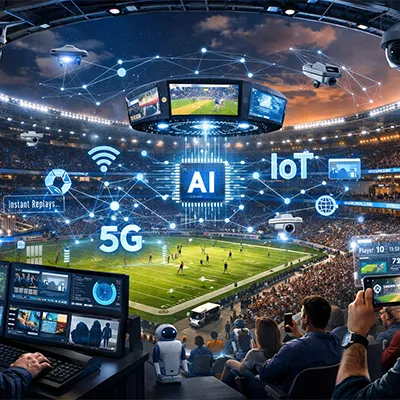
Smart stadiums rely on the power of AI and IoT, which are primary in their intelligence and adaptability. The data regarding temperature, air quality, crowd density, equipment behavior, and energy consumption are gathered by IoT sensors installed in different places within the venue. This data is then analyzed using AI algorithms to determine patterns, predict and control responses.
Video analytics driven by AI are useful in improving security by identifying suspicious activities, abandoned packages or crowded areas. Predictive maintenance systems involve the use of machine learning to predict the occurrence of equipment failures in order to minimize the downtime and cost of maintenance. Together, AI and IoT transform sports venue technology into an activation system rather than a reactive one, which is self-optimizing.
Smart Stadium Technology for Fan Experience Enhancement
In competitive sports markets and entertainment markets, fan experience is now a highly important differentiator. Fan experience for smart stadium technology is aimed at the personalization of experience, convenience, and interaction throughout the visitor experience. Mobile apps serve as virtual friends, providing navigation, real-time updates, in-seat order placement and interactive information.
IoT-enabled location-based services can be used to do targeted promotions and contextual notifications. AR functionalities improve real-time viewing and player statistics, replays and engagements. The high-speed connection guarantees the continuity of sharing and streaming, and transforms spectators into participants of the event narrative.
Data-Driven Operations and Commercial Intelligence
In addition to fan engagement, sports venue technology has been central in business intelligence and revenue optimisation. Information gathered through ticketing mechanisms, retail purchases, and flows of people offers good insights into the behavior of consumers. These insights help in dynamic pricing, better placement of concessions and better activation of sponsorship.
In the case of the B2B stakeholders, smart stadium solutions have a quantifiable ROI in terms of enhanced operational efficiency, as well as the diversification of revenue streams. Analytics can also help venue operators to use capital investments to justify their investments, leverage better partnerships, and align their technology roadmaps with their long-term business objectives.
Sustainability and Energy Management through Smart Stadium Solutions
Sustainability has become a strategic consideration to owners of stadiums and municipalities. The technology of smart stadiums allows implementing sustainability programs based on data because it controls and streamlines energy, water, and waste management applications. Smart lights can be modified by the natural lighting and occupancy, smart HVAC can be used to cut back on energy use and still be comfortable.
With the help of sophisticated monitoring platforms, the integration of renewable energy will enable the venues to monitor carbon footprints and achieve regulatory or ESG goals. Smart stadium technology of sports venues is therefore important in ensuring environmental responsibility and cost performance balance.
Integration Challenges and Interoperability Considerations
Although this is beneficial, the deployment of sports venue technology faces challenges in areas of system integration, cybersecurity, and scalability. Most of the venues have old infrastructure that needs to be combined with the new digital platforms. Different systems of stadium technology are interoperable, which will require a standardized protocol and close coordination with the vendor.
Cybersecurity is another area of great concern due to the fact that connected stadiums handle sensitive information in terms of payments, identities and surveillance. A powerful security system, 24/7 surveillance, and compliance with laws regarding data security must be incorporated with smart stadium solutions to make the stakeholders trust the solutions adopted in the stadium.
Comparison of Traditional vs. Smart Stadium Technology Models
| Aspect | Traditional Stadium Model | Smart Stadium Technology Model |
| Operations | Manual and reactive | Automated and data-driven |
| Fan Engagement | Passive viewing experience | Personalized and interactive |
| Energy Management | Fixed consumption patterns | Adaptive and optimized |
| Security | Human-dependent monitoring | AI-enabled predictive systems |
| Business Insights | Limited post-event analysis | Real-time and predictive analytics |
This analogy shows that technologies that drive smart stadiums transform the ways operations and commercial results are delivered.
Vendor Ecosystem and Industry Collaboration
Within the context of sports venue technology, the key to success lies in the cooperation of technology vendors, infrastructure companies, event management agencies, and regulators. There is no single vendor providing an end-to-end solution, and smart stadium technology ecosystems are based on interoperability and strategic partnerships.
This setting is an opportunity to B2B technology suppliers to provide modular solutions that can smoothly integrate with existing stadium architectures and thus be easily scaled to fulfill their needs. Another way that industry collaboration speeds up innovation is their standardization, best practice sharing, and minimization of the implementation risk.
Future Outlook for Smart Stadium Technology Adoption
The future of sports venues technology is associated with increased autonomy, personalization, and more extensive application of digital twins. Simulations based on AI will enable the operators of the stadium to experiment virtually without making physical changes. With edge computing, it will be possible to make quicker decisions with a low latency, particularly those that are safety-related.
With the changing expectations of fans, solutions in smart stadiums will be more geared towards the hybrid experiences that combine the physical presence with the digital one. The new generation of stadium technology systems will not support events only, but it will actively influence the way audiences experience sports and entertainment.
Strategic FAQ Summary for Industry Decision-Makers
The smart stadium technology is based on the principle of connecting all the different systems together on a single operational platform that allows real-time monitoring and automatic decision-making. Smart stadiums sports venue technology is value-based because of its efficiency, fan experience, and business insights acted upon. The smart stadiums role of AI and IoT is grounded, as they allow predictive analytics, automation with intelligent components, and adaptive environments. The technologies of smart stadiums have stopped being the future; they are now running industry protocols to competitive, sustainable and future-ready venues.
Conclusion: Redefining the Stadium as a Smart Business Platform
Within the context of sports venue technology, stadiums are becoming smart business platforms that go well beyond event hosting. Smart stadiums help stadiums to run efficiently, interact with their audiences in a more meaningful way, and be flexible to changing needs. To B2B stakeholders, the technology adoption of smart stadium is not a one-day endeavor but a resilient, data-driven ecosystem that can be utilized to achieve long-term growth.
With the sports and entertainment industry still in the process of digitalization, the technology of sports aspects will continue to be a key element of innovation, the way the venues are managed, the way fans are connected, and the way the value is generated throughout the stadium lifecycle.
 Media Pack Download
 Newsletters
 Industrial Events