
Essential Sports Ground Equipment for Safety Performance and Compliance
Long before the first whistle, someone has usually walked the pitch. They have tugged at a goal frame, pressed a heel into a soft patch and looked twice at the sky. Spectators rarely notice this routine, yet it often decides whether a match day passes safely.
Good equipment makes that routine possible. A well-run sports ground needs four things: equipment to play the game, equipment to protect people, equipment to look after the surface, and tools and records that show it has been checked. The exact list depends on the sport, the surface, the age of the players and the level of competition.
It helps to think of Sports Ground Equipment as one connected system. A new goal is only as safe as its anchoring. A quality surface performs only as well as its upkeep. An inspection matters only when someone acts on what it finds. Seen this way, buying equipment is the start of the job, not the end of it.
What safety equipment does every sports ground need?
Every ground needs protection against its most likely and most serious risks: unstable structures, hard impacts, stray balls, poor boundaries and medical emergencies. Start with a walk-through and a written risk assessment. Then choose Sports Safety Equipment that answers what you find.
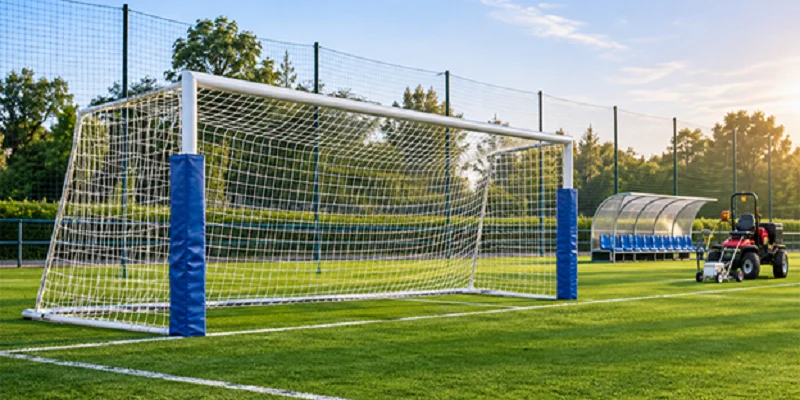
Goalposts deserve attention first. The US Consumer Product Safety Commission (CPSC) notes that most movable metal soccer goals weigh about 68 to 227 kg (150 to 500 lb). Its goal safety guidelines, which are voluntary, advise anchoring or counterweighting these goals at all times. Small net pegs are meant to hold the net, not the frame.
The same guidance carries a lesson that is easy to miss. Most of the incidents the commission investigated did not happen during a match. They tended to occur when goals were left unattended. Safe storage therefore matters as much as safe play. Secure idle goals, remove their nets and never let anyone climb or hang on them.
Other Sports Ground Safety Equipment depends on the activity. Common examples include post padding, ball-stop netting, perimeter barriers, dugout protection, flexible corner flags and covers for sockets or drains. Padding should stay firmly in place. Netting should be free of tears and sagging sections. Barriers should guide spectators without crowding the players’ run-off space.
Emergency readiness belongs on the same list. Keep stocked first-aid kits, a stretcher and an automated external defibrillator (AED) where trained people can reach them quickly. Check batteries, pads and expiry dates, and keep the ambulance route clear.
Weather needs a plan too. The US National Weather Service advises organisers to have a lightning safety plan and follow it without exception. It also advises waiting at least 30 minutes after the last thunder before play resumes. Dugouts, sheds and rain shelters are not safe refuges. Name one person to watch the weather, ideally someone who is not coaching or officiating.
How does field equipment affect performance?
Field equipment affects performance by making play consistent. When goals are the correct size, lines are clear and the surface behaves predictably, athletes can focus on the game instead of adjusting to the ground.
Sports Field Equipment includes goals, posts, nets, wickets, boundary markers, line-marking systems and sport-specific training aids. The wider category of Athletic Facility Equipment may also cover hurdles, landing mats, throwing cages, team benches, scoreboards and floodlights. Each item should suit the sport and the people using it. A frame designed for adults, for instance, may be a poor choice for a junior session.
The surface is the largest piece of equipment on any ground, although it is rarely described that way. It influences footing, ball bounce, ball roll and the force a body absorbs after a fall. Uneven turf or worn high-traffic areas can change all of these.
Professional Sports Ground Equipment is often built for heavier use, finer adjustment or the demands of a specific competition. Still, a “professional” label proves very little by itself. Ask which standard the product meets, which version was used for testing and whether the evidence covers the exact model you are buying. A community ground with sound, suitable and well-kept equipment can be a far better place to play than an expensive venue where checks have slipped.
Which maintenance equipment keeps a playing surface safe?
The right maintenance equipment depends first on whether the surface is natural or synthetic. Using the wrong machine, or the right one at the wrong time, can damage the very surface you are trying to protect.
For natural grass, Ground Maintenance Equipment usually includes mowers, rollers, aerators, spreaders, sprayers, irrigation systems and line markers. Mowing keeps grass at a suitable height. Aeration relieves compacted soil so air and water can move through it. Rolling needs judgement, because too much of it, especially on wet ground, can add to compaction.
Synthetic turf calls for a different kit, such as brushes, groomers, debris-removal machines and infill depth gauges. It is not maintenance-free. Penn State’s Center for Sports Surface Research explains that infill helps cushion impact and that routine care helps reduce surface hardness. It advises checking seams, inlaid and painted markings and busy areas closely. Follow the turf maker’s instructions for infill depth and approved machinery.
Surface hardness is measured as Gmax, where a higher number means a harder surface. Under the ASTM F1936 specification, each test point should read below 200 when measured by the prescribed method. This is a limit, not a target, and some sports bodies set stricter rules. Penn State advises testing at least yearly, and more often on heavily used fields. Results from different testing devices should not be compared as if they were the same.
Good Sports Field Maintenance Equipment also needs care of its own. Service machines on schedule, keep blades and guards in good condition and train every operator. Before play, make sure tools, hoses and loose parts are off the field.
A simple rhythm works well. Look before each use, maintain according to wear and weather, and book deeper inspections at set intervals. After storms, heavy bookings or non-sporting events, check the ground again.
What does sports facility compliance involve?
Compliance means showing that your facility meets the rules that apply to it. These may come from national law, local authorities, sports governing bodies, competition organisers, insurers and manufacturers. No single certificate covers every sport or every country.
The standards themselves show why context matters. In Britain and Europe, BS EN 748 relates to football goals, while BS EN 16579 covers playing field equipment more broadly, including its inspection. In the United States, ASTM F2950 addresses soccer goal safety and performance. For artificial turf, the FIFA Quality Programme separates levels such as FIFA Quality, aimed at recreational, training and grassroots football, and FIFA Quality Pro for professional play. World Rugby requires artificial turf used for competitive contact rugby to meet Regulation 22, and compliant fields must be retested within two years. Confirm the current edition of any requirement before you buy or test.
Sports Facility Compliance Equipment can include hardness testers, infill gauges, measuring tapes, load-testing tools for goals, lux meters for lighting, safety signs, out-of-service tags and inspection software. Owning a tester does not make someone qualified to certify a facility. Some assessments need calibrated instruments and a competent or accredited specialist.
Records connect equipment to accountability. One UK local authority guide for football goals describes three layers: a visual check before each use, a recorded operational inspection at least every six months and an annual main inspection. Your sport, location or manufacturer may require something different, but the layered approach is a useful model.
A good inspection record answers five questions. What was checked? Who checked it, and when? What was wrong? What action was taken? Who approved the equipment for use again? If an item is unsafe, take it out of service at once and make sure nobody can use it by mistake. A fault that is written down but left in play is still a fault.
How should you choose and prioritise equipment?
Put serious hazards first, legal and competition requirements alongside them, and upgrades after both. A new scoreboard can wait. A loose goal, exposed fitting or damaged barrier cannot.
Before placing an order, consider how the ground is really used. How many hours is it booked each week? Do children, adults or several sports share it? Where will heavy items be stored, and who will move them? Are spare parts and trained service support available?
Then look beyond the purchase price. Installation, testing, servicing, repairs and eventual replacement all belong in the budget. Ask for test reports, installation instructions, maintenance schedules and warranty terms in writing. Finally, give each important item an owner. Shared responsibility can quietly become nobody’s responsibility.
Frequently asked questions
How often should sports ground equipment be inspected?
Carry out a visual check before use. Schedule detailed inspections according to the applicable standard, manufacturer’s advice, risk level and frequency of use. Inspect again after damage, severe weather or relocation.
Is certified equipment always safe to use?
No. Certification shows that a product, sample or installation met defined criteria under stated conditions. Wear, poor installation, missing parts or misuse can make it unsafe later.
Who is responsible for sports ground compliance?
Responsibility depends on local law and contracts. Owners, operators, schools, clubs and event organisers may each hold duties, so name them clearly in writing.
The real measure of a good ground
A good sports ground is not defined by how much equipment it owns. It is defined by whether that equipment is suitable, secure, maintained and checked. Players may remember the score, but they also remember a surface they could trust.
Before the next session, take that walk around the ground with fresh eyes. Test your assumptions, note what has changed and fix urgent problems before play begins. Safety, performance and compliance are not three separate projects. They grow from the same habit of paying attention.
 Media Pack Download
 Newsletters
 Industrial Events