
Ultra HD AR and Remote Production: The Future of Sports Broadcasting Tech
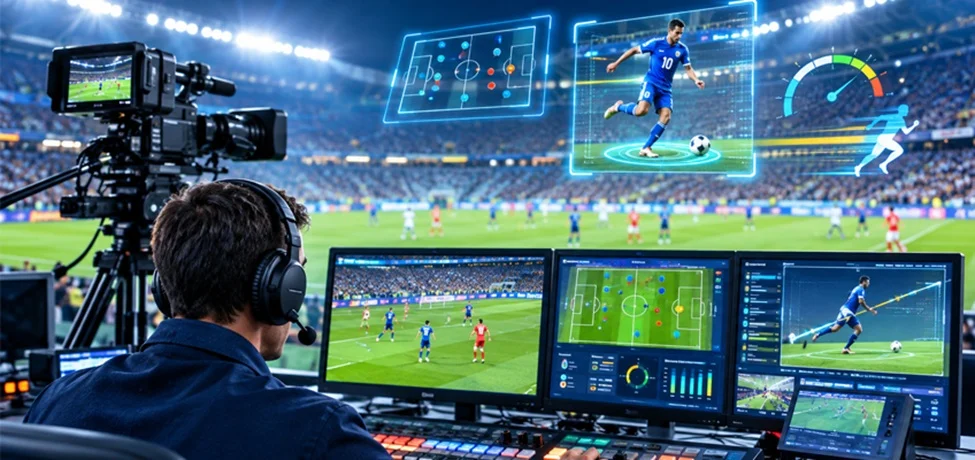
Broadcasters face a tough equation: viewers want sharper pictures, richer data and more events, while budgets and travel schedules stay tight. Three technologies are helping solve it at once. Ultra HD broadcasting raises picture quality, AR sports broadcasting turns data into something fans can see and understand, and remote production cuts the cost and complexity of covering live events.
Each is useful on its own. Together, they’re changing how live sport is made, delivered and enjoyed, and they’re defining the next chapter of sports broadcasting technology.
This guide covers what each technology does, where they overlap, and how to approach them. It’s written for broadcasters, sports media professionals and curious fans.
What Is the Future of Sports Broadcasting Technology?
In short: The future of sports broadcasting rests on three pillars: Ultra HD (4K and beyond) for lifelike picture quality, augmented reality (AR) for real-time data and graphics layered onto live action, and remote production, which lets crews produce live events from a central hub instead of an on-site truck. Together they cut costs, speed up delivery and make the viewing experience richer and more personal.
Now let’s look at each one.
Ultra HD Broadcasting: Why Sharper Pictures Change the Game
Ultra HD broadcasting usually means 4K resolution, roughly four times the pixels of standard HD. In a sports context, though, resolution is only part of the story. The real gains come from a package of improvements:
- High Dynamic Range (HDR): Brighter highlights and deeper shadows. A day-night cricket match or a floodlit football game finally looks the way it does in the stadium.
- Higher frame rates: Fast action like a tennis serve or a boundary shot stays smooth instead of blurring.
- Wider colour range: Team kits, pitch markings and sponsor logos look true to life.
Sport is arguably the best use case for Ultra HD. A drama can get away with a soft picture, but a live match can’t. Viewers want to see the ball cross the line, the grimace on a face, the spin on a delivery.
What Ultra HD Sports Production Demands
Producing in Ultra HD isn’t as simple as buying better cameras. It reshapes the whole chain:
1. Cameras and lenses that can handle 4K at high frame rates.
2. Bandwidth and compression that move huge amounts of data without visible quality loss.
3. Graphics and replay systems built to work at the same resolution.
4. Monitoring and quality control so a single weak link doesn’t spoil the picture.
This is where Ultra HD sports production meets the other two pillars. Heavy video needs fast, reliable networks, and those same networks make remote production possible.
AR Sports Broadcasting: Turning Data Into Something You Can See
Sport has always been full of numbers. Augmented reality sports broadcasting makes them visible by placing graphics directly into the live picture, so they appear to sit on the pitch, court or track.
Common Uses of AR in Live Sports
- Tactical overlays: Offside lines, passing lanes and formations drawn over the field.
- Player tracking: Speed, distance covered and heat maps tied to the athlete on screen.
- Virtual sponsor placements: Brand messages that appear to be painted on the grass or boards, and can be swapped by region.
- Studio visuals: Analysts standing beside life-size 3D replays or virtual scoreboards.
Why AR Works for Audiences
Good AR doesn’t add clutter. It answers a question the viewer already had. Was that really offside? How fast was that serve? Why is the defence so stretched? When a graphic explains the game in a second, new fans feel included and longtime fans learn something.
For rights holders, AR also opens new revenue. Interactive and localized graphics give advertisers more than a static logo, which makes sports media technology more valuable commercially.
One caution: AR should serve the story, not steal the show. The best producers treat graphics like a good commentator, helpful and well-timed, and they leave the screen alone during the big moments.
Remote Production Technology: The Quiet Revolution Behind the Scenes
Viewers never see remote production, but it may be the biggest change of the three.
What Is Remote Production?
In short: Remote production (also called REMI, short for Remote Integration Model) means cameras and microphones stay at the venue while the production team works from a central facility elsewhere. Video and audio travel over high-speed networks, and the directing, graphics, replays and commentary mix happen off-site.
The Traditional Model vs. Remote Production
|
Traditional OB Truck |
Remote Production |
|
|
Crew location |
On-site at the venue |
Central hub |
|
Travel and logistics |
High |
Much lower |
|
Setup time |
Long |
Shorter |
|
Staff reuse |
One event at a time |
Same team can cover several events in a day |
|
Environmental footprint |
Larger |
Smaller |
Benefits of Remote Sports Production
- Lower costs: Fewer people and trucks on the road means less spend on travel and accommodation.
- More events covered: The same crew can work a morning match in one city and an evening game in another. That’s a big deal for smaller leagues and niche sports that never justified a full truck.
- Better working conditions: Production staff spend more time at home and less time in transit.
- Sustainability: Fewer vehicles and flights reduce a broadcaster’s carbon footprint.
- Flexibility: Specialist talent, like a top replay operator, can contribute to many productions without travelling.
The Challenges Nobody Should Ignore
It isn’t all upside. Remote production solutions for live sports events depend on:
- Network reliability: A dropped connection during a final isn’t an option, so redundancy is essential.
- Latency: Even small delays can make communication between the venue and the hub awkward.
- Cybersecurity: Live feeds travelling over networks need serious protection.
- Skills and culture: Crews used to being in the same room have to learn new ways of working together.
Broadcasters that plan for these issues early are the ones getting remote production right.
How Ultra HD, AR and Remote Production Work Together
Here is the part many articles miss: these three technologies reinforce one another.
- Ultra HD needs strong networks, and the networks built for remote production provide them.
- AR needs powerful processing, which is easier to centralise in a hub than to cram into a truck.
- Remote production needs content worth producing, and Ultra HD and AR give audiences a reason to tune in and stay.
Picture a live match where 4K cameras at the stadium feed a central control room. There, one team adds real-time AR graphics, cuts replays and sends tailored versions to different regions and platforms. That’s the real promise of Ultra HD and AR technology for sports broadcasting: one production workflow, many tailored experiences.
What This Means for Different Audiences
For broadcasters and production companies: Start with a clear business case. Decide whether your priority is cost savings, new revenue or a better viewer experience, and pick the technology that fits. A pilot on a smaller event is a low-risk way to learn.
For leagues and rights holders: Remote production can make smaller properties viable to broadcast. AR gives sponsors fresh, measurable ways to reach fans.
For fans: Expect more context, sharper pictures, more choice in how you watch, and coverage of sports that were previously hard to find.
Trends to Watch in Live Sports Broadcasting Technology
- Cloud-based production: More of the workflow is moving from dedicated hardware to the cloud, making setups more scalable.
- AI-assisted production: Automated camera framing, highlight clipping and instant stats are saving time for small crews.
- Personalized feeds: Viewers choosing their own camera angles, commentary language or data overlays.
- Immersive formats: Early experiments with virtual and mixed reality viewing continue to grow.
- Higher resolutions: 8K is already being tested in places, though 4K and HDR remain the practical standard for most productions.
None of these trends will replace good storytelling. Technology works best when it gets out of the way and lets the game shine.
Frequently Asked Questions
What is Ultra HD broadcasting in sports?
Ultra HD broadcasting delivers live sport in 4K resolution or higher, often with HDR and high frame rates, for sharper, more lifelike and smoother pictures than standard HD.
How is AR used in sports broadcasting?
AR places real-time graphics such as offside lines, player stats, tactical diagrams and virtual ads directly into the live video so they look like part of the field.
What is remote production in sports?
Remote production is a method where cameras and audio capture happen at the venue, while directing, graphics and editing are handled from a central facility over high-speed networks.
Is remote production cheaper than using an OB truck?
Often, yes. It reduces travel, equipment transport and on-site staffing. Actual savings depend on network costs, the event type and how often the central hub is used.
Does remote production affect broadcast quality?
Not when it’s well designed. With reliable, low-latency networks and proper redundancy, remote productions can match or exceed the quality of traditional setups.
What are the biggest challenges of Ultra HD and remote production?
The main challenges are bandwidth, network reliability, latency, cybersecurity and training teams for new workflows.
Will AR and Ultra HD replace traditional sports broadcasting?
They’re more likely to upgrade it. Core elements like commentary, camera work and storytelling stay central. These tools add depth and efficiency on top.
Final Thoughts
Sports broadcasting has always chased one goal: making viewers feel closer to the action. Ultra HD brings the picture closer, AR brings the understanding closer, and remote production brings the whole thing within reach of more events and more audiences.
If you work in this space, the question isn’t whether to adopt these technologies but how, and in what order. Start small, test honestly, learn from the first broadcast, and build from there. Fans will keep expecting more, and the teams that prepare now will be the ones delivering it.
 Media Pack Download
 Newsletters
 Industrial Events