
Stadiums of Tomorrow: How AI is Enhancing Sports Venue Operations
Artificial Intelligence or AI is quickly becoming the go to solution for many companies. Technologies across the field of AI are changing how contemporary stadiums work and become improved and more secure for the crowds and the management. AI is not only helpful in management of the stadiums as part of infrastructural development, but also in altering the ways and experience fans view the stadiums. The stadiums of tomorrow are already starting with the management of the crowd and ending with the management of new conversations with fans.
Enhancing Fan Experience with Personalization
Another area that AI is gradually revolutionizing sports stadium is through delivery of personalized fan experience.
Current day stadiums have AI applications and algorithms that are being used to understand fans’ preferences for the types of foods they prefer, what merchandise they tend to purchase or even seating preferences by fans. For this reason, gathering and analyzing such data helps stadiums to better target appropriate marketing offers, promotion events and fan-related services. This means when a fan walks into the stadium, he or she can be offered personalized incentives through his/her smartphone, for instance, a fan can be offered a 15% discount on a favorite team jersey. Many other services are also coordinated by AI, including directing fans around a stadium and providing updates on the quickest path to ones’ seats, restrooms, or concession stands.
Intelligent Crowd Management for Enhanced Safety
One major event in managing crowd is always a challenge when dealing with large congregated crowds especially in a stadium. Since the population of people attending an event could be as high as tens of thousand, their safety and comfort becomes central to consideration. A special emphasis is made on the AI- powered systems used to monitor crowd movements, which are important for crowd management. Such systems employ facial recognition, videos, and motion sensors to identify possible security risks, for example, excessive people density in specific zones, fights, or intrusion. Such data can allow the stadium staff to cater for incidents as they occur thereby minimizing event-related risks to the fans.
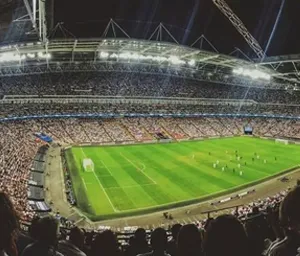
AI is also being applied to manage crowd traffic as well. These systems can detect the density of the crowd and open and close part of the door to prevent a slowdown of movement and to ensure the people in the venue move around the area effectively. It not only enhances the fans’ experience but also reduces the possibility of an incident or a setback.
AI-Optimized Ticketing and Seating
AI is also reducing the ticketing process in stadiums as well. In the case of ticketing, predictive analytics enables the AI systems to forecast which events are likely to attract crowd in order to enable managers of venues to set appropriate price levels in real-time. This dynamic pricing model means that the tickets required are priced to match the market price base on demand needful for the stadium needed for optimization of revenues needed.
Further, the seating configurations are also being enhanced by AI. They can drive insights from past performance of attendance and from these; determine which seats are likely to be occupied and therefore arrange the seats. This aids the stadiums in achieving maximally utilised seating conditions where there is no vacant area and all the fans get the best vantage view of the event.
Smart Stadium Maintenance and Energy Efficiency
The stadiums of the future are also employing artificial intelligence for intelligent maintenance as well as energy management. The use of AI will also allow the stadium to keep track of every structure, equipment or system it has in a real-time basis and alert the management once there is a possibility of a structure giving out or an equipment failing to work. These predictive maintenance systems assist operators at these stadiums to prevent expensive overhauls and guarantee optimal working order of the arena in case of an event.
AI is also being used in the management of power consumptions within a stadium. One can watch the use of electricity by integrating smart sensors and AI algorithms to control lighting, heating, and cooling systems. For instance, low lighting in the areas that is not used or lower HVAC in some parts of the stadium depending with the number of people that are present. This not only lowers costs on energy such but it also has the added advantage of lowering the ecological footprint of stadiums as well.
AI in Concessions and Merchandise
The two are focusing on revolving income policies while AI is revolutionizing the sale of foods and beverages in the stadiums. Fans are allowed to use AI kiosks and applications to order food and beverages while remaining in their seats and free from the long queues at food stations. AI systems deal with real-time data to focus on replenishing popular items in the shop and minimizing on stocks which are not likely to be sold in the near future. Demand surge: Based on the consumers’ purchase pattern, AI can help the stadiums prepare for high traffic during such events.
In the same way, merchandise experience is being boosted by AI technology. Recommendation systems informed by artificial intelligence can recommend merchandise based from the fans past purchase, affiliation to a particular team, or their preferred players. This creates better sales and interacts with the fans to create a better fan base experience.
Conclusion: A Glimpse into the Future
The use of Artificial Intelligence is revolutionizing how sport stadiums work and thus improving in terms of smart technologies, security and fans.
Starting with the site-specific fan experiences even the crowd management, everything revolves around artificial intelligence in stadiums of future. Going forward, there are likely to be further developments in the ability of AI technologies, in practical application and functionality which will enhance the ways in which the stadiums will operate and the way in which the fans engage with the game. Soon people can visit a sports venue and this will be fun accompanied by some form of an interaction all due to artificial intelligence.
 Media Pack Download
 Newsletters
 Industrial Events