
Phygital Arenas: Blending Esports and Traditional Sports in One Venue
A New Era in Sports Entertainment
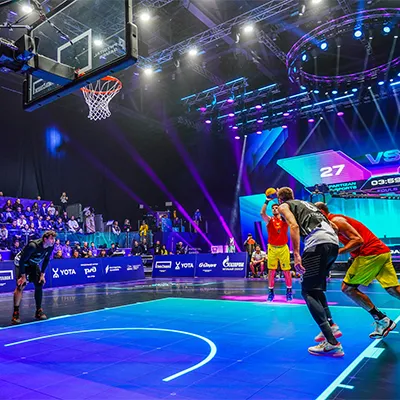
Take the fantasy of having fans watching a virtual version of a live football match, and at the same time, a football match is being played on huge LED walls in the same space. This is not a distant fantasy. The phygital sports arena - a revolution is a welcome to a new world of combining physical and digital sports experience in the same immersive ecosystem.
With the sports organizations and event planners reconsidering the audience engagement, the phygital esports venue is emerging as the next frontier. It is the convergence of technology, architecture, and athleticism to attain memorable hybrid experiences. In other words, a phygital sports arena that integrates esports and physical sport is a link between the real-life competition and the virtual world of immersion.
Why the Industry Is Turning to Phygital Integration
Over the years, esports and conventional sports existed in different worlds. One was playing in stadiums and fields, and the other was playing in gleaming digital environments. Nonetheless, as viewers are demanding more interactive sports gaming facilities, there has been an explosion in the demand for these facilities. Such a shape of the future transforms the experience of competition by fans, athletes, and sponsors.
The emergence of the phygital esports venue is explained by two important reasons: the rapid introduction of immersive technology, and the necessity to retain younger and more high-tech audiences by being in touch with conventional sports. Gen Z consumers not only enjoy passive watching, but they also demand interaction, gamification, and multi-sensory engagement, which are all elements of the phygital concept of the sports arena.
Inside a Phygital Arena: What Makes It Different
A sports phygital venue is much more than a stadium containing several digital screens. It is a smart room fused with sensors, motion sensors, holographic screens, AR areas, and interactive viewing experiences. The idea is to have the spectators included in the act so the line is lost between the gamer and the athlete.
Perhaps it is time to discuss the way in which the phygital sporting arena that fuses esports with physical sport functions in reality. A live game can offer spectators the chance to view in-time player statistics and biometrics information and AR virtual leaderboards. Simultaneously, esports players can reproduce such real-life events in an online field, whereby they can engage in synchronized tournaments. This forms a two-tiered interaction - one with the physical world, one with the digital one - that is, seamlessly connected by information and design.
| Component | Role in a Phygital Arena | Impact on Experience |
| Smart Sensors | Track physical movements and synchronize with digital avatars | Enables real-time simulation of physical gameplay |
| Augmented Reality (AR) Walls | Overlay digital graphics on live events | Enhances fan immersion and engagement |
| Interactive Pods | Allow fans to switch between watching and participating | Bridges passive viewing with active gaming |
| Holographic Projection | Displays esports players or virtual opponents on the field | Creates a merged esports & traditional sports arena environment |
This overlap will turn the spectators into participants and athletes into hybrid players, and the foundation of a hybrid sports gaming venue will be struck.
Designing the Future: The Blueprint of Phygital Sports Spaces
The design of a phygital venue structure in sports is as new as the technology behind it. Architects and engineers are also trying out modular seating, movable LED floors, and dynamic lighting systems capable of transforming a football design into an esports one in minutes.
The ability to be versatile is the main factor when it comes to designing a phygital arena to host esports events and traditional sports events. The architecture should also be physically active-friendly without taking a toll on the digital infrastructure. This necessitates high-quality connectivity, high-speed networks, and high-quality sound systems capable of serving real-world matches as well as virtual tournaments.
The phygital gaming stadium should involve interdisciplinary collaboration with regard to construction. The architects, digital artists, game developers, and event producers must work hand in hand to ensure that the physical and virtual layers will be compatible.
The Question of how to construct an esports and live sports competition hybrid venue
The question most developers are posing nowadays is: how to create a hybrid between esports and live sports competition that will be both realistic and interactive?
It starts with three pillars, namely technology integration, spatial design, and audience experience.
- Technology Integration:
A hybrid sports gaming facility works on the flawless connection of the physical performance and the digital simulation. IoT systems, AI-powered analytics, and cloud computing will make sure that all the movements, sounds, and light cues will be reflected in both worlds correctly. - Spatial Design:
An effective phygital sports arena must possess adaptable infrastructure. The use of retractable seating, projection screens, and VR pods creates the ability to seamlessly change between sporting formats, e.g., between a basketball championship and a multiplayer esports battle. - Audience Experience:
In the core, the esports and traditional sports arena should appeal to its viewers. The fans are not content with spectators alone anymore; they do not want to be observers. The phygital model incorporates digital leaderboards, a fan voting system, and AR filters, which also guarantee that the spectators are a part of the performance.
Interestingly, the phygital sports venue is not limited to entertainment. Universities, gyms, and corporate fitness programs are now considering hybrid arenas of training, virtual tournaments, and collaborative events, which are the beginning of the phygital ecosystems in industries.
Phygital Venue Solutions for Traditional Sports Clubs and Esports Teams
There is an exceptional change in the manner in which sports organizations are engaging. Phygital venue solutions are offered by many conventional clubs as a way of keeping relevant in the digital age, to traditional sports clubs and esports teams.
As an example, we can mention football clubs that create official esports teams or cricket competitions that test virtual tournaments that run in parallel with their real-life competitions. Implementing the phygital solutions in the traditional sports clubs and esports teams, these entities not only attract the younger audience but also increase the possibility of monetization with virtual ticketing, NFT collections, and sponsorships.
In the case of esports teams, a phygital esports venue has credibility and the ability to access a physical world. It makes gamers show up as real-world athletes, and this breaks the culture that the digital and traditional fans had.
Market Insights: The Rise of the Phygital Sports Economy
As per the recent industry forecasts, the market of the hybrid sporting gaming venue is projected to expand exponentially as more investors and cities start realizing its value in terms of tourism and community building. Organizers of major events are already scheming esports and traditional sport arenas for the next generation of Olympic and World Cup events.
| Year | Projected Market Value (USD) | Key Growth Drivers |
| 2025 | $1.8 Billion | AR/VR integration and smart stadiums |
| 2027 | $3.4 Billion | Expansion of hybrid tournaments |
| 2030 | $6.1 Billion | Global adoption of phygital sports arenas |
Such cities as Seoul, Tokyo, and Dubai are also at the forefront of trying phygital sports arena, which is a combination of esports and physical sports, changing entertainment districts into interactive areas. This is likely to transform the economies of urban areas, which is a combination of leisure, technology, and innovation.
Phygital Arenas and the Future of Sports Broadcasting
The old-fashioned broadcasting is not enough to satisfy the modern hybrid audience. An esports phygital venue offers unlimited narrative possibilities to streamers. Cameras with AI can record physical and virtual angles and enable broadcasters to combine esports images and real-time images of the players.
Such a two-layered coverage forms the basis of a new genre of broadcasting phygital casting. Suppose an esports player performs the same move virtually, and a commentator describes the real kick of a footballer - a narrative similarity that makes the viewers attached to the screen.
Through the application of phygital venue in the sporting activities, broadcasters and media companies are in a position to offer audiences interactive and data-driven experiences that are not limited to the conventional parameters of viewership. Immersive camera settings, fan chats, and augmented overlays are redefining the consumption of games.
Challenges in Building the Perfect Phygital Sports Arena
The road to the complete functionality of a phygital sports arena is not paved as easily as it may sound. The price of integration, digital infrastructure, and cross-platform compatibility is still expensive. Another problem that developers should solve is that of latency, motion synchronization, and the security of data, so that they can be sure of real-time precision in a live event.
The issue of aesthetics and functionality is also a challenge to designers who are planning a phygital arena related to esports and sports events. Excessive digital input may overwhelm physical players, and excessively small digital input may reduce the digital experience to a dullness. Therefore, it is both an art and a science to establish a balance between the real and the virtual.
Additionally, phygital space of physical sports clubs and eSports teams should be in compliance with the standards of sustainability. Display power efficiency, recyclability, and use of renewable energy is becoming a new reality in the future-ready arenas.
The Fan Experience: Emotion Meets Innovation
The real achievement of a phygital sports venue, which unites esports and physical sporting activity, is the emotional impact. Once the heartbeat of the fans is in sync with the digital mob cheers, when they applaud the athlete as well as the avatar, then that is when the magic takes place.
The sports gaming arena makes spectators become storytellers as they can interact, share, and even affect the result of live events using technology, making it a hybrid. All the cheering, all the gestures, and all the clicks are included in one story.
As we further venture into this new frontier, all that becomes apparent is that the esports & traditional sports arena is not all about technology. It is about human interconnection that is augmented with innovation.
Conclusion: Building the Future, One Phygital Arena at a Time
The phygital sports arena is a paradigm shift in the way we look at sports, games, and community interaction. Combining physical and digital reality, the phygital esports venue lies at the interface of entertainment and evolution - a venue where online champions can interact with real players, compete, and collaborate.
To developers, investors, and sports organizations, the answer is obvious: invest in phygital venues designed for sports, look at designing a phygital arena in esports and traditional sports events, and study phygital venue solutions in traditional sports clubs and esports teams in order to future-proof their presence in an ever-more hybrid world.
It is no longer a question of whether the world will accept phygital sports arenas, but when the immersive, interactive, and intelligent spaces are going to be the pulse of sport the world over.
 Media Pack Download
 Newsletters
 Industrial Events