
Facial Recognition at the Turnstile: The Future of Stadium Entry
Introduction to Facial Recognition in Stadiums
Facial recognition in stadium controls the future of how fans experience a sporting event, especially at a time when convenience, security, and digitization have become a top priority. What then is the stadium facial recognition technology? Or in other words, it is a biometric system that scans the face of an individual and compares it to a digital identity, usually to a ticket or membership account, which makes it possible to access stadiums in a secure way and as swiftly as possible.
This technology has its origins on early law enforcement uses and in high security facilities such as airports. Its implementation in the sphere of public places was building pace throughout the last ten years, and most of the significant sporting and performance events sought its opportunities. Nevertheless, the past years and years following the pandemic have speeded up the implementation of it in stadiums because of the necessity of contactless entrance and strong security measures.
Never before have stadiums been so complicated digital environments. Facial recognition technology are ideal for this new infrastructure, whether it takes the shape of mobile ticketing and app-based seating routing or AI-enhanced crowd management solutions. The emerging tendency of facial recognition as the means of entrance to the stadiums by 2025 indicates that biometric control is not a temporary trend but an inevitable change in the stadium management.
How Facial Recognition Works at Turnstiles
Have you ever wondered how the stadium entrance facial recognition system operates? It is rather effortless to fans and quite efficient to organizers. The operation of a facial recognition turnstile system is as follows:
- Pre-Event Registration: By buying the tickets online or using an official stadium app, the fans share a selfie. It is this selfie that is retained safely and attached to their digital ticket.
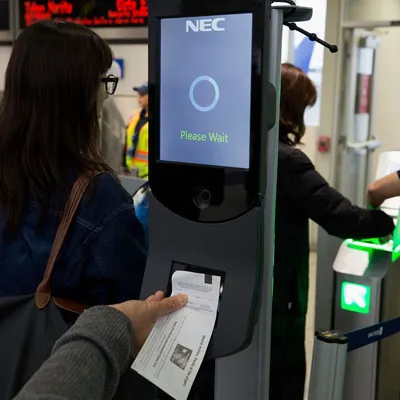
- Arrival at Stadium: Once at the stadium, the visitors go to a smart gate that has a facial recognition turnstile system. Real time cameras scans their face.
- Identity Match & Validation: The live scan is compared with the available biometric information. When it has been confirmed that a match can take place, the turnstile is opened automatically, no need to scan QR codes, no messing with phones or paper tickets.
The use of this facial scan digital ticket improves the whole entry process.
Hardware usually encompasses 3D cameras, infrared sensors, and edge computing component, whereas software is based on image recognition software supported through AI. It will be accurate and secure as it will combine the current ID databases or ticketing systems.
Such vendors as Clear, NEC, and Trueface have established themselves on the industry as market leaders with customizable stadium level facilities that provide efficient access control with an emphasis on reduced friction.
Benefits of Facial Recognition for Stadium Entry
Stadiums are changing operations visibly and multi-dimensionally as a result of the benefits of facial recognition entry:
- Faster Crowd Throughput: Checking the manual and using of barcode scanner normally form bottlenecks at gates. Facial recognition in stadiums can minimize the time required to log in, which is 10-15 seconds per individual, throughout the corridor, to less than 2 seconds, and visibly improve the flow of the crowd, as well as wait time.
- Enhanced Security & Identity Verification: Contrary to the traditional tickets, facial info is not easy to fake or replicate. The system does not only reveals the identity of the ticket holder; it can also warn prohibited people or suspected security hazards in real time.
- Touchless/Contactless Experience: Physical distancing is a health concern given the post-COVID period. Face recognition does not involve the exchange of tickets or direct touch of shared touchpoint and ensures a 100 percent touchless and contactless entry.
- Improved Fan Experience: The same can be used in-stadium to offer personalization on entry (seat location, in-store offers etc) or further by enabling orders to be made at vending machines using facial recognition.
All of these will raise the rate of intelligence, safety, and fan-friendliness of the visit to the stadium.
Security & Privacy Concerns
Facial recognition stadium systems are associated with grave security and privacy issues in spite of the benefits that it projects.
The first is the permission and data storage issue. The fans should be allowed to choose voluntarily and the systems should be clear on how long facial data is held, where and by whom. The privacy is increased because much of it is in encrypted, tokenized state and is not reversible to images of faces.
Strict guidelines on the use of biometric data are outlined in laws such as the California Consumer Privacy Act (CCPA) in the United States and the General Data Protectors (GDPR) in the European Union.
Requirements of these frameworks should be met by stadiums to prevent them using the law to deal with them.
In addition, there exist wider ethical dilemmas regarding surveillance. The opponents of this technology have doubts that AI in facial recognition systems of stadiums will turn mass surveillance into a standard, and such systems will be used improperly. There is an opinion among the masses - some of the fans are glad because it is so convenient, but some others are afraid of being spied on all of the time.
Consequently, transparency, data minimization, and consent may become the key to the success of mass adoptions, as crucial as the performance of technology in question.
Pilot Programs and real-world use cases
Popular enthusiasm over facial recognition is already tested or currently implemented in a few high-profile stadiums, providing data on its practical success.
- La Liga (Spain): Facial recognition turnstile systems have also been tested out by some Spanish clubs and allow an improvement of the VIP experiences and faster entry in the stadium by the season-ticket holders.
- Tokyo Olympics 2020: One of the largest applications of facial recognition systems was at the sporting event when multifaceted facial recognition system designed by NEC was implemented with the help of it, athlete, staff, and media were able to access the event.
- NFL & Clear Partnership: The Seattle Seahawks and Denver Broncos teams have joined hands with Clear and enabled facial scan digital ticket systems to be used in expediting the entry into the stadiums.
- Atlanta’s Mercedes-Benz Stadium: They launched the use of facial recognition in making concession payments and gain entry to the premium spaces in association with Wicket.
The facial recognition face case studies are favorable so far with shorter queues and wait times, higher security, and contented customers. Yet, they also stress the importance of planning, education of a mass audience and means of consent to its implementation.
AI & Tech behind the Scenes
The strength of the AI in facial recognition stadium systems cannot be overestimated. Facial recognition is not just an image matching: it is based on deep learning, neural networks and real-time analytics.
This is the way AI and machine learning benefit performance:
- Facial Detection: Recognizing a human face facing different lightings and directions.
- Feature Extraction: Making a unique facial image by mapping important features such as eyes, nose and jawline to produce a distinctive faceprint.
- Matching: Comparing the live scan with the stored templates with the help of the AI algorithms.
- Continuous Learning: The system learns as it goes, it learns how not to give false positives and to accommodate minute changes on the face.
Clear, NEC, Trueface, and Wicket are companies that have developed cloud and edge platform systems that host tens of thousands of souped-up per-minute scans. Such systems do not simply require a plug in to run rather the backend architecture needs to be apposite, auditing there should be compliance, as also benchmarking should be done so that these systems can perform well in a high-volume application such as stadiums.
The Future Outlook
What the future of stadium facial recognition will reach, however, is a closer union with the stadium itself and correspondingly intelligent application:
- Biometric Ticketing: The biometrics would replace tickets completely. The face of the fan is combined with the ticket with the immediate connection to the payment system and the perks program along with the seat.
- Multi-Modal Identity Verification: Playing with their face even allows other security authentication methods to be used in some stadiums, such as voice recognition, phone proximity or even, palm scans.
- Integration with Loyalty Programs: Just consider yourself entering the gigantic stadium and been greeted by name, offered or upgraded at personal level just because of a facial scan tied to your fan account.
- Widespread Adoption by 2025: Analysts expect that facial recognition entry to stadiums will become widely deployed in the United States of America, Europe and Asia at least in high-value stadiums, music events, and elite sports leagues by 2025.
- Collaborations with Event Tech: Biometric tech companies may end up collaborating with event management companies, and that will result in end-to-end ticketing, entry and engagement, and feedback service.
The bottom line is that the facial recognition turnstile system is a new experience and quite soon it is going to become the next level.
Conclusion
A calendar of streamlined entry and increased security levels, fully personalized experiences, and digital transformation, facial recognition has proved to be an important tool that delineates a new phase of intelligent venue management at stadiums. Although there are still privacy and ethical issues, the prospect of more compact, secure and sensory-enhancing platforms is certainly enough to guarantee that facial recognition stadium systems will lead the future of sports and entertainment.
With 2025 in sight, the one thing that rings a bell in our ears is that the face is soon going to be the new ticket.
 Media Pack Download
 Newsletters
 Industrial Events