
The Role of Construction Consultants in Delivering Complex Sports Venues

Quick answer: Sports venue construction consultants act as the owner's technical and commercial advisers from feasibility to opening night. They shape the brief, control cost and schedule, coordinate designers and contractors, and manage risk, so a stadium opens on time, on budget and ready for crowds, broadcasters and event day operations.
A stadium is never just a building. It is a transport hub, a broadcast studio, a restaurant, a retail space and a safety-critical crowd machine, all wrapped in one structure that has to be ready for a fixed opening date. Miss that date and a season, a tournament or a sponsor deal can slip with it.
That is why owners, clubs, governments and developers bring in sports venue construction consultants. If you have ever wondered who sits between the vision and the finished concrete, steel and turf, this article walks through exactly that.
What do sports venue construction consultants actually do?
Think of them as the owner's experienced second pair of eyes. They do not pour concrete or design seating bowls. They make sure the people who do are working from the right brief, the right budget and the right schedule.
In practice, construction consultants for sports venues usually cover five jobs:
- Feasibility and brief: testing whether the venue makes sense, what it should hold and who will use it before money is committed.
- Cost planning: building a realistic budget and keeping it honest as the design changes.
- Procurement advice: choosing the contract route, shortlisting designers and contractors, and reading the small print.
- Delivery oversight: tracking progress, quality and safety on site against the plan.
- Handover and operations: making sure the venue can actually host events, not just pass inspection.
A good sports facility consultant is also a translator. Architects speak design, contractors speak programme and price, and the owner speaks outcomes. The consultant keeps all three conversations pointed at the same finish line.
Why is sports venue construction harder than other buildings?
Because almost everything about it is extreme. Sports venue construction combines large spans, heavy structural loads, tight sightlines and enormous crowds, and every one of those pushes the design and the budget in a different direction.
Here is what makes sports facility construction so unforgiving:
- Fixed deadlines. A tournament or season start does not move because the roof steelwork arrived late.
- Complex systems. Pitch drainage, floodlighting, retractable roofs, broadcast cabling, ticketing and security all have to work together.
- Crowd safety. Evacuation, sightlines, accessibility and structural performance under moving crowds are regulated and non-negotiable.
- Many stakeholders. Clubs, leagues, governing bodies, sponsors, broadcasters, city authorities and fans all want something different.
- Long-term use. A stadium that looks good on opening night but costs too much to run becomes an expensive problem for decades.
One slip, such as a late design change to premium seating, ripples through structure, services, cost and programme. Consultants exist largely to see that ripple coming before it hits the site.
How do consultants shape sports venue construction planning?
The biggest wins happen before anyone breaks ground. Good sports venue construction planning is mostly about asking uncomfortable questions early: Who fills this seat on a Tuesday night? Can the site handle 60,000 people leaving at once? What happens to the budget if the roof design changes?
This is where stadium construction consulting earns its fee. A consultant stress-tests the brief, builds a cost model, and flags the risks that only show up once you have seen a few of these projects go wrong.
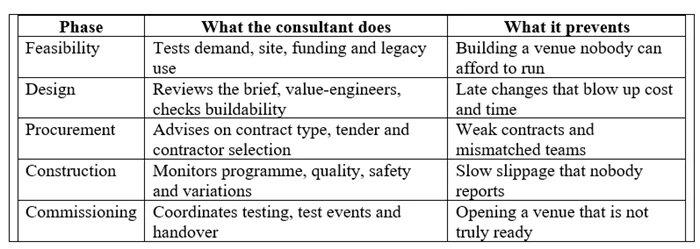
Notice that the consultant's influence is highest at the start, when changes are cheap, and lowest at the end, when they are painful. That is the whole argument for bringing them in early.
Where does project management make or break a stadium?
Once construction starts, sports venue project management becomes a daily discipline rather than a planning exercise. A stadium has hundreds of moving parts, and most delays do not come from one dramatic failure. They come from small things nobody owned.
A consultant-led project management approach usually focuses on four habits:
1. One source of truth. A single programme, a single cost report and a single risk register that everyone trusts.
2. Interface management. Structure, façade, MEP, pitch, IT and broadcast teams all touch the same spaces. Someone has to referee the overlaps.
3. Early warning. Reporting that says "we are drifting" in week six, not "we are late" in month eighteen.
4. Hard decisions, fast. Design freeze dates and change control that people actually respect.
Here is a simple example. Say the seating contractor needs access to the lower bowl, but the roof team is still lifting steel above it. Without coordination, one team waits and the cost clock ticks. With a consultant tracking the interface, the sequence is agreed weeks earlier, and nobody loses a month.
The same logic applies to quality and safety. Independent oversight on site means defects are caught while they are cheap to fix, not discovered during the first test event with a crowd in the stands.
How do you choose the right sports facility consultant?
Not every construction adviser understands stadiums. Before you appoint one, check a few things:
- Relevant track record. Have they worked on arenas, stadiums or major sporting facilities, not only offices and housing?
- Full-lifecycle experience. Can they support you from feasibility through to operations, or only one stage?
- Independence. Do they advise you alone, without commercial ties to a contractor or supplier?
- Sector knowledge. Do they understand league, federation and broadcast requirements, plus local safety codes?
- Clear reporting. Will you get plain-language updates on cost, time and risk every month?
- Chemistry. Do they ask sharp questions and tell you things you would rather not hear?
That last point matters more than people expect. A consultant who only agrees with you is not protecting your project.
Frequently asked questions
What is a sports venue construction consultant?
A sports venue construction consultant is an independent adviser who guides an owner through planning, cost control, procurement and delivery of a stadium or arena. They represent the owner's interests, not the contractor's.
When should you hire a consultant for a stadium project?
As early as possible, ideally at feasibility stage. Early advice on the brief, site and budget costs far less than fixing problems after design or construction has begun.
How is stadium construction consulting different from general construction consulting?
Stadiums involve crowd safety, broadcast needs, large structural spans, event operations and tight fixed deadlines. Consultants with sports experience know these demands and the usual traps.
What does sports venue project management include?
It covers programme control, cost reporting, risk management, design coordination, contractor management, quality and safety oversight, and commissioning through to handover.
Do consultants help after the venue opens?
Often yes. Many support defect resolution, operational readiness, test events and lessons learned, which helps the venue perform well in its first seasons.
The bottom line
Sports stadium development succeeds or fails on decisions made long before opening night. The right consultant brings structure to the brief, honesty to the budget and discipline to the schedule, which is why experienced owners treat them as a core part of the team rather than an optional extra.
If you are planning a venue, start with the questions this article raised: Is the brief tested? Is the budget realistic? Does someone own every interface? If the answer to any of those is "not yet", that is where a consultant should begin.
Planning a stadium or arena? Talk to an experienced sports venue construction consultant about your brief, site and timeline before the design is locked in.
 Media Pack Download
 Newsletters
 Industrial Events